
During a practical nursing program
HESI LPN course exams and the PN exit
HESI LPN exams are the practical-nursing versions of Elsevier’s in-school assessments. You take them at the end of courses such as fundamentals, pharmacology, and pediatrics, and many programs add an exit exam before they will clear you for the NCLEX-PN.

Practical nursing programs move quickly. A HESI that felt distant in week two is suddenly the gate for clinical. The exam is trying to see whether you can give safe care to predictable patients, notice a change, and get help. It is not trying to see whether you can manage an unstable intensive-care assignment. That difference is the whole reason an LPN form exists beside the RN form.
Nursing Elites does not work for Elsevier. The HESI LPN catalog is original practice grouped by the courses below.
Three HESI products, three jobs
The HESI A2 is for applicants. It is academic. The exams on this page are for enrolled practical nursing students. The HESI RN page is for registered nursing students, whose items assume a wider scope. If your acceptance letter says “HESI” and you have not started classes, you want the A2 page. If your instructor scheduled a proctor for the end of maternity, you want this page.
Match the set to the course that just ended
The LPN catalog follows the courses these programs actually grade:
- Fundamentals of nursing
- Adult health and medical-surgical nursing
- Pharmacology
- Nutrition, which is large enough in this track to deserve its own sets
- Maternal newborn
- Pediatrics
- Mental health
- Community health
- Leadership and management
- CAT exams and the LPN exit group
Nutrition is the course students under-practice because it feels like common sense. Exit items still ask about therapeutic diets, swallowing risk, and what a poor intake means for healing. Pediatrics items ask about growth, safety, and how a child’s dose and fear differ from an adult’s. Do not leave either subject until the final mixed exam.
Fundamentals keeps returning inside adult health: infection prevention, mobility, pain, and recording intake. If those rationales still surprise you, stay with fundamentals for two more evenings before you add a harder adult-health set.
What the exit exam is for
The LPN exit exam samples the program. Schools use it, sometimes with a CAT version, to decide on remediation or on clearance to apply for the NCLEX-PN. The exit exam can feel like the license exam because both ask about safe care. The exit exam is still a school tool. A pass or a fail on it is not a board result.
Review for it by client, not by textbook chapter title. Take one set of adult health, one of mother and child, one of mental health, and one of pharmacology. Write down the action you missed. In the last days, use a mixed exit set to see whether you can switch subjects every item, which is what the real sitting feels like.
The correct action is often the LPN action
Stems will offer an assessment or a treatment that sits outside practical-nursing practice. The credited response is the one you are educated and directed to perform, plus the report you make when the finding is new. Choosing the most dramatic option is a common miss. So is choosing an action that waits when the patient in front of you is unsafe right now.
Leadership items ask about organizing care and speaking to the right person. They rarely ask you to redesign the unit. If the item mentions a task you may delegate, ask whether the patient is stable and whether the task is in that person’s job. Those two questions settle more items than a leadership slogan does.
Use your program’s benchmark
HESI reports a score that programs turn into a rule: the minimum, the number of tries, and the remediation between tries. The rule at a school in another state is not evidence about your school. Screenshot the policy when the course starts, because the argument after a low score is a bad time to hunt for it.
A Nursing Elites practice result is not a HESI conversion score. It is a record of which explanations you could reproduce. Your faculty and, later, the board of nursing make the official calls.
If the school uses ATI instead
Some practical nursing programs proctor ATI rather than HESI. The scope advice on this page still helps. The practice sets should then come from the ATI LPN guide and its catalog, so the last week matches the vendor you will see on test day.
Related reading
- HESI LPN practice catalogCourse sets, CAT sets, and the LPN exit sets.
- NCLEX-PN guideThe licensure exam after the exit requirement.
- HESI A2 guideOnly if you are still applying, not if you are in class.
- How long nursing school takesPractical nursing is the shorter path, with exams packed tighter.
- Trauma-informed careA useful lens for mental-health and communication items.
A review split before a HESI LPN exit exam
Official sources
Use Elsevier for the product and NCSBN for the license exam that follows the exit requirement.
Five HESI LPN-style practice items
These items stay inside practical-nursing practice. They are original Nursing Elites items.
-
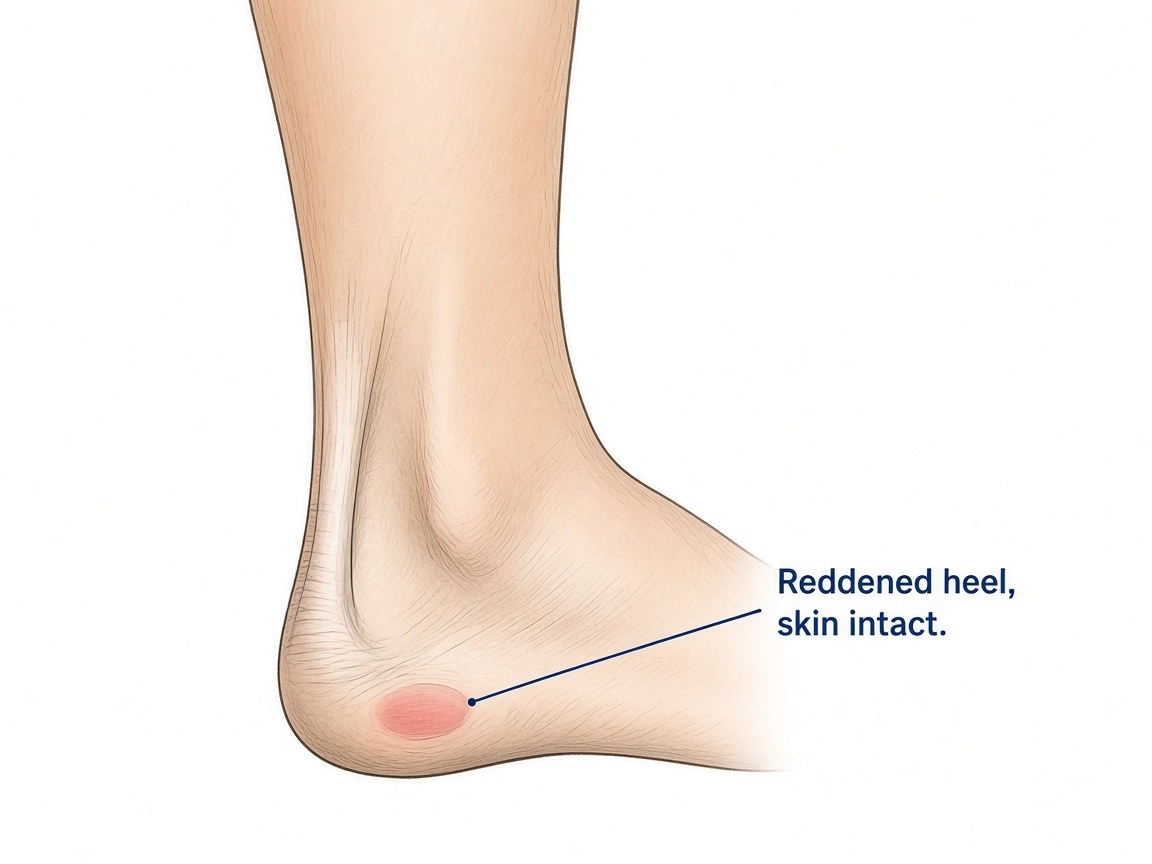
While bathing a client, the LPN sees a new reddened area on the heel, skin intact, like the drawing earlier on this page. What should the LPN do?
- A. Ignore it because baths cause redness.
- B. Relieve pressure from the heel and report the finding.
- C. Massage the red area firmly.
- D. Apply a heating pad without an order.
Answer: B.
A new red area over the heel, with the skin still intact, is an early pressure injury until it is shown to be something else. Pressure is what caused it, so the heel is floated or repositioned so the bone is not pressing the skin into the mattress. The finding is reported so the RN and the care plan can add protection. Choice A assumes every red spot in a bath is from hot water. A pressure point that stays red is not dismissed that way. Choice C, firm massage, can shear tissue that is already injured. Choice D adds heat with no order, which increases the metabolic demand of tissue that already has a poor blood supply. Intact skin does not mean there is nothing to do. It means you caught the injury before an open wound.
-
Metformin is ordered with breakfast. The tray has not arrived, and the client is nauseated and has not eaten. What is the best action?
- A. Give the dose on an empty stomach.
- B. Hold the dose until the client can eat, and report the nausea and the delay.
- C. Double the dose at lunch.
- D. Crush the tablet into a full glass of water and insist the client drink it.
Answer: B.
The order ties metformin to breakfast because the drug is taken with food, and because a client who is not eating is at risk of low blood glucose from other diabetes drugs that may be on the same regimen. New nausea is also a finding, not a reason to force a tablet. Hold the dose, tell the RN that the client has not eaten and is nauseated, and wait for direction rather than inventing a new schedule. Choice A ignores the “with breakfast” part of the order. Choice C doubles a dose that was never given, which is a medication error. Choice D forces fluid and a crushed tablet on a nauseated client and still does not solve the empty stomach. Some metformin tablets should not be crushed at all. Follow the order you have, and report the reason you could not carry it out.
-
A parent asks why a 2-year-old cannot take the adult tablet. What is the best explanation?
- A. Children and adults always use the same dose.
- B. A child’s dose is calculated from weight or age and is not the adult tablet.
- C. Tablets are unsafe for every person over age 2.
- D. The pharmacy label can be ignored if the parent prefers the adult tablet.
Answer: B.
A toddler’s liver and kidneys handle a drug differently, and the body weight is a fraction of an adult’s. The safe amount is calculated, often in milligrams per kilogram, and then dispensed as a liquid or a child-sized tablet. Choice A would overdose a 2-year-old if the adult tablet were given. Choice C is too broad: many children older than 2 take tablets when the dose and the child’s ability to swallow allow it. The problem is the adult strength, not the fact of a tablet. Choice D invites the parent to override the label. The label is the dose that was calculated for this child. Explain that, and do not split an adult tablet at the bedside unless pharmacy has already made that the ordered dose.
-
A client with heart failure is looking at this label for one cup of canned soup. Which statement is correct?
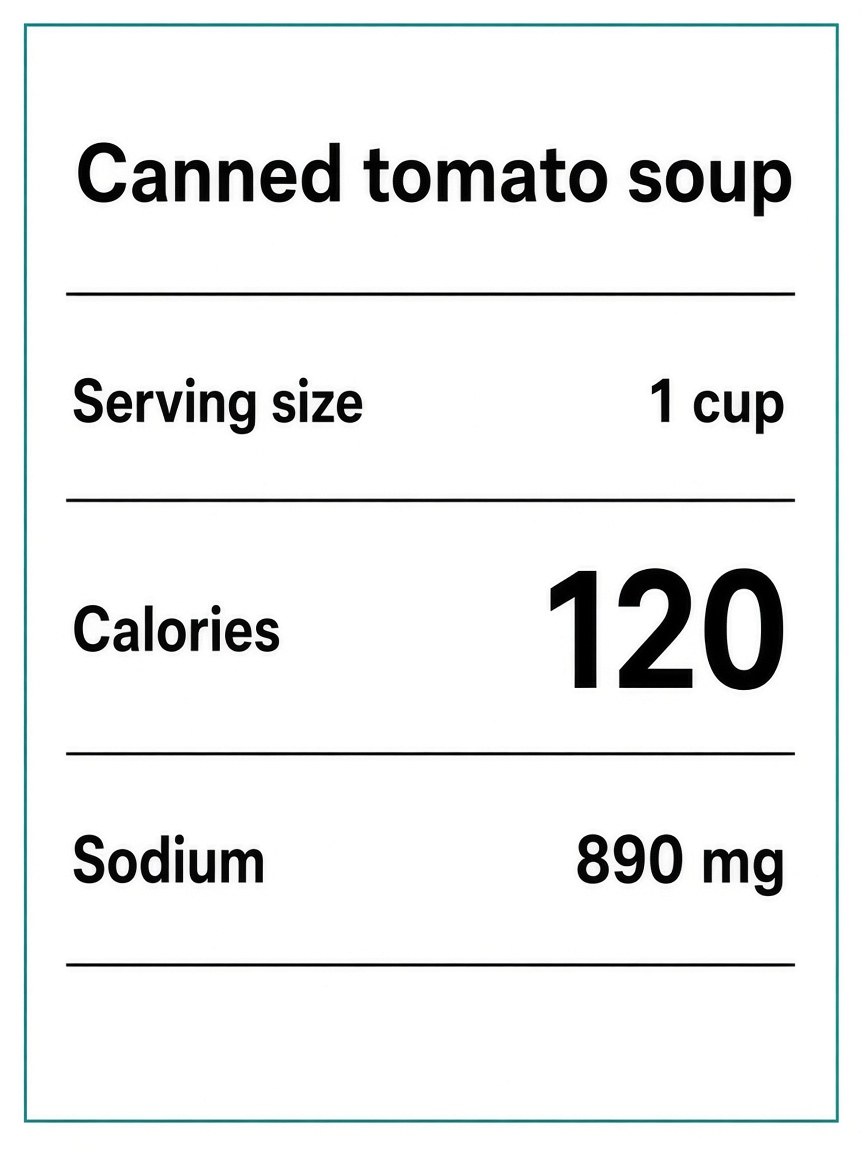
Read the sodium line, not the calorie line. The question is about one cup as printed. - A. One cup has less than 100 mg of sodium.
- B. One cup has 890 mg of sodium.
- C. One cup has 890 calories.
- D. One cup has 120 mg of sodium.
Answer: B.
The label lists sodium as 890 mg for one cup. That is the number the question asks you to read. Many heart-failure teaching plans ask clients to keep a whole day near 2,000 mg or less, so a single cup at 890 mg is a large share of the day, which is why canned soup shows up in diet teaching. Choice A would describe an unsalted food, not this label. Choice C moves the 890 onto the calorie line. The calorie line says 120. Choice D does the reverse and puts 120 on the sodium line. The miss is swapping two numbers that are both on the label. Point at the word “sodium” before you choose.
-
An LPN is asked to insert a central venous line. What is the correct response?
- A. Insert it if the client agrees.
- B. Decline, because the task is outside the LPN role, and tell the RN.
- C. Ask a nursing assistant to insert it.
- D. Watch a short video and then insert it.
Answer: B.
Inserting a central venous catheter is a sterile invasive procedure performed by a provider or another clinician credentialed for it. It is not an LPN task, and it is not a task that becomes an LPN task because the client agrees or because a video was available. The correct response is to decline and to tell the RN so the right person is found. Choice A treats consent as a substitute for scope. The client can agree and the task can still be outside your license. Choice C pushes the procedure further from the person who is trained for it. Choice D confuses watching a skill with being licensed and privileged to perform it. Scope questions are answered from the role, not from confidence or from how simple the video made the skill look.
Questions students ask
What is a HESI LPN exam?
HESI LPN exams are Elsevier assessments for practical and vocational nursing programs. They include course exams and an exit exam that many schools use before students sit for the NCLEX-PN.
How is HESI LPN different from HESI A2?
The HESI A2 is an admission exam in academic skills such as math and reading. HESI LPN exams assume you are already in a practical nursing program and ask about nursing care.
Does every LPN program use the same HESI exit score?
No. Schools set their own benchmark, retake rule, and remediation plan. Read the policy for your program before you treat a number from another school as your target.
What should I practice on Nursing Elites?
Match the set to the course: fundamentals, pharmacology, adult health, pediatrics, mental health, nutrition, leadership, or the LPN exit group in the HESI LPN catalog.