
Nursing school admission
What is the ATI TEAS 7?
The ATI TEAS 7 is a standardized admission exam that measures reading, mathematics, science, and English before a student starts nursing school. It has 170 questions. One hundred fifty of them count. The four sections are timed for 209 minutes.

Assessment Technologies Institute publishes the Test of Essential Academic Skills. Version 7 is the form most nursing and allied-health programs assign now. The exam does not ask you to write a care plan or calculate a heparin drip. It asks whether you can read a passage, work a proportion, read a graph, name how a body system works, and fix a sentence. Those are high-school and early-college skills, used here as a filter before a clinical program.
Nursing Elites is not affiliated with ATI. The practice sets linked from this page are original. They follow the public content outline so you can rehearse the same skills. They are not retired TEAS forms.
Who is asked to take it
A program, not ATI, decides that the TEAS is required. You will usually see the rule in the admission checklist beside the GPA, the prerequisite grades, and the application deadline. Some schools test on campus. Others send you to ATI or to a testing center. A few accept a score you already earned for another application, if it is recent enough for their policy.
Read that policy before you book a seat. Schools differ on the minimum composite, the minimum in science, how old a score may be, and how many attempts they will look at. A score that clears one college can miss the cutoff at the college across town. If you are comparing programs, the HESI A2 guide describes the other admission exam you may be handed instead.
The four sections, in one sitting
You will see 170 items. Twenty of them are pretest items that ATI uses to try out future questions. They do not change your score, and they are not marked. Plan as if every item counts. The scored work is 150 items, split the way the table shows.
TEAS 7 questions in each timed section
A short break is built in after mathematics. Use it. Science is the longest block of items, and it comes when you are already two hours into the appointment. Eat something ordinary beforehand, and do not save a new topic for the night before science.
Reading: 45 questions, 55 minutes
The reading section asks you to use a text, not to remember a novel from class. Passages may be a few paragraphs, a set of directions, a notice, or a pair of sources. Thirty-nine items are scored.
Key ideas and details, 15 scored items
These items ask for the main idea, a stated detail, the meaning of a direction, or the order of events. A summary question wants the claim that covers the whole passage, not a vivid example from the second paragraph. When a question says “according to the passage,” stay inside the passage.
Craft and structure, 9 scored items
Here the question is how the writing works. You may be asked to separate a fact from an opinion, to use context for a word, or to name the author’s purpose. Purpose is the job of the piece: to inform, to persuade, to instruct, or to describe. Tone is a clue, not the whole answer.
Integration of knowledge and ideas, 15 scored items
These items use more than one source, or a source plus a chart. You compare two passages, judge whether evidence supports a claim, or move a number from a graphic into a conclusion. If the graphic and the paragraph disagree in your reading, look again at the axis and the units before you pick a side.
Mathematics: 38 questions, 57 minutes
A calculator is provided for the calculator portion of the section. Know which items allow it, because mental arithmetic still shows up, and a calculator will not rescue a setup that uses the wrong operation. Thirty-four items are scored.
Numbers and algebra, 18 scored items
Expect fractions, decimals, percents, ratios, proportions, and equations with one variable. Convert among forms before you calculate. A question that asks “what percent” is a different operation from a question that asks “what is 20 percent of.” Order of operations matters on expressions that mix parentheses and multiplication. Round only when the item tells you to, and round at the end.
Measurement and data, 16 scored items
This block is graphs, tables, basic statistics, geometric measures, and conversion between household and metric units. Read the title and the units before the numbers. A rise on a graph is not automatically a large rise. For conversions, write the unit you are leaving and the unit you need, then choose the factor that cancels the unit you do not want. Area and perimeter are different questions. Do not multiply every number you see.
Metric conversion is a frequent miss, which is why the ATI TEAS 7 practice catalog keeps a separate metric set beside the math sets.
Science: 50 questions, 60 minutes
Science carries the most items. Forty-four are scored. The work is general science and anatomy at a pre-nursing level, not pathophysiology from a later medical-surgical course.
Human anatomy and physiology, 18 scored items
You need the orientation words, the major organs, and the job of each system: respiratory, cardiovascular, digestive, nervous, muscular, reproductive, integumentary, endocrine, urinary, immune, and skeletal. A useful study check is to name, for each system, what it moves, what it regulates, and what failure would look like in plain language. You are not asked to stage a disease.
Biology, 9 scored items
Cells, macromolecules, genetics, and the role of microorganisms are the core. Know the difference between a cell membrane and a cell wall, between DNA and a protein, and between a bacterium and a virus at the level of structure. Mendel’s laws show up as prediction, not as a history lesson.
Chemistry, 8 scored items
Atomic structure, states of matter, solutions, acids and bases, and simple reactions are enough. You should be able to say what happens to concentration when a solution is diluted, and what the pH scale is doing when a number gets smaller. Balancing a long equation is less important than knowing what a reactant and a product are.
Scientific reasoning, 9 scored items
These items hand you a small study and ask what it can support. Identify the measurement, the comparison, and the conclusion that goes past the data. A correlation in a paragraph is not automatically a cause. Tools and units belong here too: a graduated cylinder measures volume, not mass.
English and language usage: 37 questions, 37 minutes
You have about a minute an item. Thirty-three are scored. The section is spelling, grammar, punctuation, and whether a sentence fits its reader.
Conventions of standard English, 12 scored items
Spelling, sentence boundaries, and agreement live here. A comma splice and a fragment are the usual traps. Read the whole sentence aloud in your head. If you need two periods, you have two sentences.
Knowledge of language, 11 scored items
These items ask which revision is clearer, which word fits the audience, and how a paragraph should be ordered. The formal choice is not always the longest choice. Prefer the sentence that a patient or a classmate could follow.
Vocabulary and writing, 10 scored items
Word parts do a lot of work: a prefix such as hyper- or hypo- changes the whole term. You may also be asked to place a sentence in a draft or to say what a paragraph still needs. That is planning, not literary analysis.
How a question can be asked
On the computer version you will still see ordinary multiple-choice items with one best answer. You can also see items that allow more than one answer, items that ask you to type a number or a word, items that ask you to click a region on a figure, and items that ask you to put steps in order. The paper form, where a school still uses one, stays closer to multiple choice. Practice the computer styles if that is how you will test. A correct idea in the wrong slot is still wrong on an ordered item.
What the score report can and cannot tell you
ATI reports a total score and a score for each of the four sections. The total is not a simple average you should recompute in the parking lot. Use the section scores. A composite that looks acceptable can hide a science score under the line your program set.
There is no national passing score. The program publishes the number it wants, the sections that have their own floors, and the waiting period before a retake. If you retest, study the section that missed, not the section you already cleared. Retaking without a change in method usually repeats the same miss.
Nursing Elites cannot tell you the score a particular school will accept, and it does not guarantee admission. Use the school’s current admission page for the cutoff, the fee, and the dates.
TEAS 7 beside the HESI A2
Both exams are admission tools. They are not interchangeable. If your program names one, that is the one you prepare for.
| ATI TEAS 7 | HESI A2 | |
|---|---|---|
| Who publishes it | Assessment Technologies Institute | Elsevier HESI |
| What is fixed | Four sections for every candidate: reading, math, science, English | The school chooses the academic sections |
| Length | 170 items, 209 minutes of section time | Depends on how many sections you are assigned |
| Science | One science section that mixes anatomy, biology, chemistry, and reasoning | Often separate exams for anatomy, biology, and chemistry |
| English | One English and language usage section | Often split into vocabulary and grammar |
The longer comparison, including how a school might use learning-style items that do not affect an academic cutoff, is on the HESI A2 page.
Practice the section you will sit
The ATI TEAS 7 exam catalog is organized the way the test is organized: English and language usage, TEAS math, TEAS reading, TEAS science, and metric conversions. Start with a short set in your weakest section, read the rationale, and only then add a longer set. A rationale that tells you why the other options fail is the part worth rereading.
A workable order for a month is reading and English in the first week, because they reward daily short sessions, then math with conversions, then science last so the anatomy is fresh. Adjust that if a placement quiz shows science is already the gap. Do not add a new resource every time a practice score dips. Stay with one outline and repair the misses.
Related pages
- ATI TEAS 7 practice catalogSection sets for reading, math, science, English, and metric conversions.
- Understanding the TEAS examA shorter applicant’s note on what the exam is for.
- Conquering a nursing entrance examHow to prepare when the school has not yet said TEAS or HESI.
- HESI A2 guideThe other common admission exam, built from sections the school selects.
- What you actually need for nursing schoolThe rest of the admission file, after the exam score.
Official sources
The counts above are the ones ATI prints on its exam-details page. Nursing Elites is not ATI. The five items that follow were written here.
- ATI TEAS exam details, with the 170-item blueprint and the four timers.
- How to register for the TEAS. Ask the program which proctor it accepts before you pay.
Five TEAS-style practice items
These are original Nursing Elites items, one for each skill the exam mixes. They are not from an ATI form.
-
A clinic notice says blood draws start at 7 a.m. and the last draw is at 3 p.m. Which statement is supported by the notice?
- A. Patients may arrive at 4 p.m. for a blood draw.
- B. Blood draws are offered from 7 a.m. through 3 p.m.
- C. The clinic is closed on weekends.
- D. No order is required for a draw.
Answer: B.
A reading item of this kind only lets you use sentences that are actually on the page. The notice names a start time, 7 a.m., and an end time, 3 p.m., so the supported statement is that draws are offered across that window. Choice A moves the end time an hour later than the notice allows. Choice C adds a weekend rule the notice never mentions. Choice D adds an order rule the notice never mentions. When a choice sounds sensible in a real clinic but is not written in the passage, it is still wrong on a reading item.
-
A student answers 18 of 24 items correctly. What percent is that?
- A. 65 percent
- B. 70 percent
- C. 75 percent
- D. 80 percent
Answer: C.
Percent means “out of 100,” so the setup is part divided by whole, then multiplied by 100. Here the part is 18 and the whole is 24: 18 ÷ 24 = 0.75, and 0.75 × 100 = 75. Choice A, 65 percent, is closer to 16 of 24 (16 ÷ 24 is about 0.67). Choice B, 70 percent, would be about 17 of 24. Choice D, 80 percent, would be about 19 of 24. A common miss is to subtract 18 from 24 and treat the leftover 6 as the percent. The leftover is the number missed, not the percent correct.
-
Which conversion is correct?
- A. 1 gram = 100 milligrams
- B. 1 liter = 100 milliliters
- C. 1 kilogram = 1,000 grams
- D. 1 meter = 10 centimeters
Answer: C.
The metric prefixes used on the TEAS move by thousands for the units in this item, not by hundreds and not by tens. Kilo- means one thousand, so 1 kilogram is 1,000 grams. Choice A is short by a factor of ten: 1 gram is 1,000 milligrams, not 100. Choice B has the same error in the volume line: 1 liter is 1,000 milliliters, not 100. Choice D is the length error: 1 meter is 100 centimeters, not 10. If you remember only one ladder, remember that each step from kilo to the base unit, and from the base unit to milli, is 1,000.
-
The diagram shows an animal cell. Which labeled structure releases most of the usable energy from food?
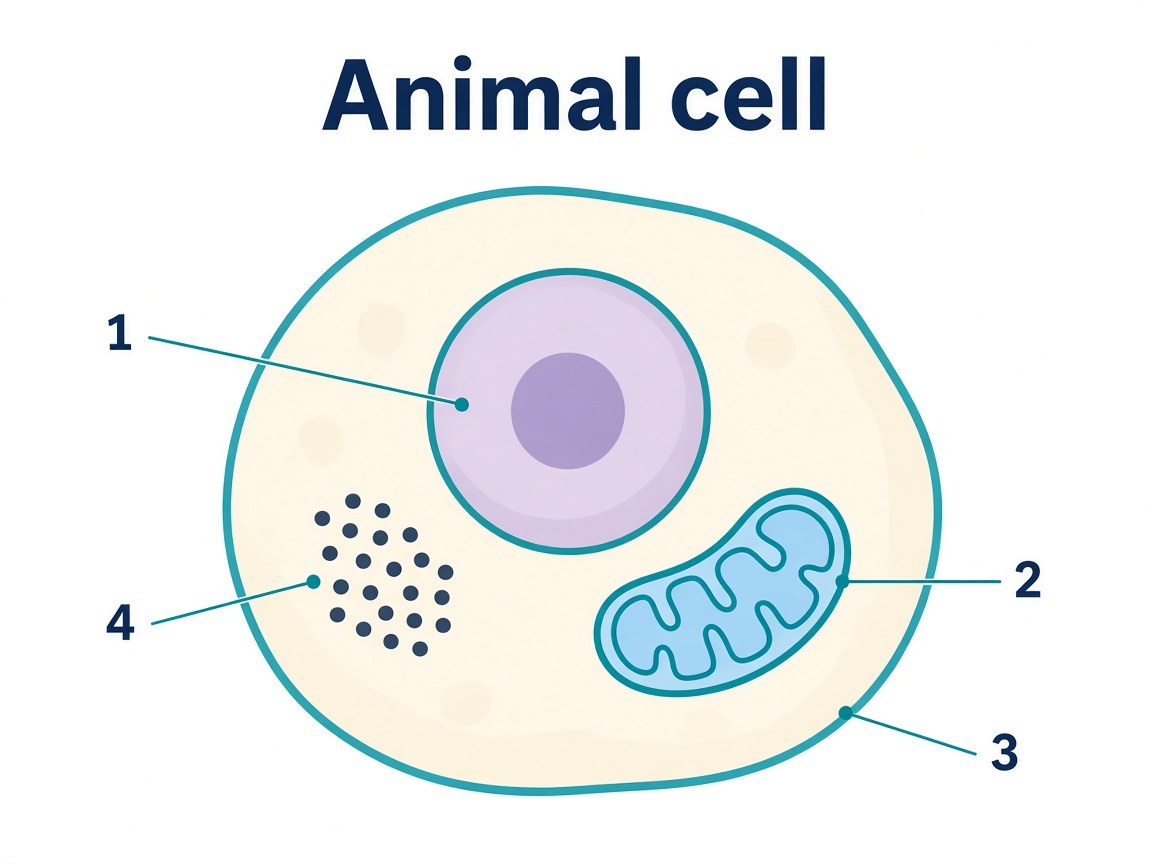
Use the numbers on the drawing. The question asks which structure releases usable energy, not which structure is largest. - A. Structure 1
- B. Structure 2
- C. Structure 3
- D. Structure 4
Answer: B.
Structure 2 is the mitochondrion, the organelle where most ATP is made from the energy in food. Structure 1 is the nucleus, which holds the cell’s DNA and directs what the cell builds. It does not release most of the usable energy. Structure 3 is the cell membrane, which controls what enters and leaves. Structure 4 is a cluster of ribosomes, which assemble proteins. A large nucleus is easy to pick because it dominates the drawing, but size on the page is not the job of the organelle. On a TEAS science item, match the question’s verb, “releases energy,” to the structure whose job is cellular respiration.
-
Which choice is a complete sentence?
- A. After the nurse checked the blood pressure.
- B. The nurse checked the blood pressure.
- C. Checking the blood pressure.
- D. Because the blood pressure was high.
Answer: B.
A complete sentence has a subject and a verb and can stand by itself. Choice B has the subject “nurse” and the verb “checked,” and the thought is finished. Choice A begins with “after,” which turns the clause into a fragment that still needs a main clause. Choice C is a phrase with no finite verb, so it cannot stand alone. Choice D begins with “because” and leaves the reader waiting for the result. Capital letters and a period do not repair a fragment. Read the choice out loud and ask whether a listener would still be waiting for the rest.
Questions students ask
What is the ATI TEAS 7?
The ATI TEAS 7 is the Test of Essential Academic Skills, version 7, published by Assessment Technologies Institute. Nursing and allied-health programs use it to measure reading, mathematics, science, and English before admission.
How many questions are on the TEAS 7?
The TEAS 7 has 170 questions. One hundred fifty are scored. Twenty are unscored pretest items, and you cannot tell which items are unscored while you are testing.
How long is the TEAS 7?
The four scored sections are timed for 209 minutes: 55 for reading, 57 for math, 60 for science, and 37 for English and language usage. A short break after math is part of the standard sitting. Confirm the current candidate instructions for your test date.
Is there a national passing score on the TEAS 7?
No. ATI reports scores by section and as a composite. Each school sets the score it will accept, how recent the score must be, and how many times you may test.