
During a registered nursing program
HESI RN specialty exams and the exit exam
HESI RN exams are Elsevier assessments given inside a registered nursing program. Specialty exams follow single courses. An exit exam, and sometimes a computerized adaptive version, comes later as a check on whether you are ready to leave the program and sit for the NCLEX-RN.

Students say “the HESI” as if it were one test. In an RN program it is a series. You might take fundamentals in term one, pharmacology when that course ends, maternity on its own week, and a long exit exam in the final term. Each sitting has its own score and its own rule in the handbook. Preparing for “HESI” in the abstract is how people review the wrong course.
Nursing Elites is not affiliated with Elsevier. Sets in the HESI RN catalog are original. They are organized under the same course names so you can rehearse the subject you were assigned.
Admission HESI is a third exam entirely
If you are applying and someone said you need a HESI, they almost always mean the HESI A2. That exam is math, reading, vocabulary, grammar, and the sciences the school selects. The exams on this page assume you are already learning nursing care. A high A2 score does not excuse you from a fundamentals specialty exam eight months later.
What a specialty exam is asking
A specialty exam follows a course. The catalog groups them the way faculties do:
- Fundamentals of nursing
- Pharmacology
- Medical-surgical nursing, including adult health
- Maternity and obstetrics
- Pediatrics, sometimes combined with obstetrics
- Mental health
- Nutrition
- Community health
- Leadership and management
The stem is a short patient situation. You choose the safest next action, the finding that matters, or the teaching that shows the patient understood. HESI items like converted scores and case groupings, but you should not chase the scoring trick. You should be able to say what you would do at the bedside and why the second-best option waits.
Medical-surgical exams punish memorized disease lists that never reach an action. If you can define heart failure and cannot say what daily weight, breathing, and medication adherence look like in the item, you are halfway ready. Practice until the action is the part you remember.
The exit exam is a sample of the whole program
Schools use an exit exam, and some use HESI CAT exams, as a graduation or a testing-clearance requirement. The exit exam reaches back into every course. Students who “just review med-surg” for two weeks discover that maternity, pediatrics, and mental health are still on it. The CAT versions adapt within the publisher’s rules. They are still school exams. They are not the NCLEX-RN, even when the screen feels similar.
A useful exit review is a rotation: one day of pharmacology calculations and safety, one day of adult health, one day of mother and child, one day of mental health and leadership, then a mixed set. A mixed set on day one only tells you that you are mixed. It does not tell you which course to open.
The number in the handbook is your number
HESI score reports are often discussed as a conversion score. Programs publish the benchmark they require, how many attempts you get, and what remediation you must show before the next attempt. A benchmark you saw online may belong to a different school and a different year. Copy the number from your current handbook into your notes and ignore the rest.
If you miss the benchmark, the remediation is the assignment. Repeating the same practice set until the percent looks better does not meet a faculty rule that asks for a focused review and a new attempt. Do the review they named.
Nursing Elites cannot see your program’s benchmark and does not promise that a practice percent will match a HESI conversion score.
ATI and HESI are not interchangeable practice
Some programs use ATI. Some use HESI. A few use both in different courses. The clinical ideas overlap, which is why an ATI RN fundamentals rationale can teach you something true. The item style and the score report still differ. If the proctored exam is HESI, do the last week of practice in the HESI RN catalog so the stems feel familiar.
Then the license exam
After the exit exam, the board of nursing still requires the NCLEX-RN. Use the exit result as a map of weak client needs, then move to NCLEX-style cases, including the newer clinical-judgment items. Staying on specialty quizzes after the program has ended keeps you in course-final mode.
Related reading
- HESI RN practice catalogSpecialty sets, CAT sets, and RN exit sets.
- NCLEX-RN guideThe licensure exam the exit exam is only preparing you to face.
- HESI A2 guideThe admission exam, if you are not in the program yet.
- How to pass the NCLEXWhat to change once course exams are behind you.
- The nursing code of ethicsUseful background for leadership and professional-practice items.
A review split before a HESI RN exit exam
Official sources
Elsevier describes HESI. NCSBN describes the licensure exam a HESI exit result does not replace.
- Elsevier HESI, including specialty and exit assessments.
- NCLEX.com, the candidate site for the RN licensure exam.
Five HESI RN-style practice items
Each stem is a short clinical decision. The explanation names the finding that made the other options wait.
-
The figure shows an open airway beside a narrowed one. A client with asthma is using single words, the wheeze has stopped, and the oxygen saturation is falling. What is the priority?
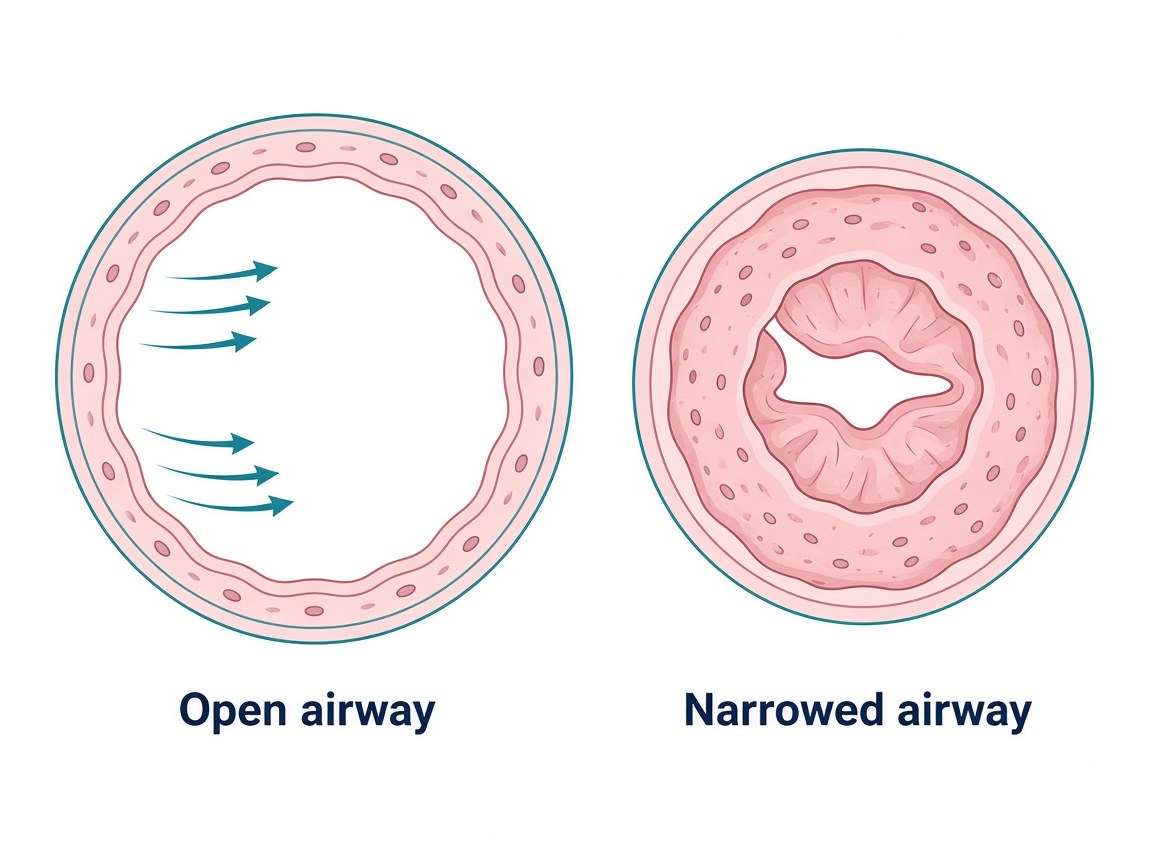
The right-hand airway is the emergency in this stem. Air is barely getting through, which is why the wheeze can disappear. - A. Ask about home triggers and start a teaching plan.
- B. Call for help and support breathing.
- C. Offer a walk in the hall.
- D. Lower the head of the bed flat.
Answer: B.
A wheeze means some air is still moving through a narrowed airway. When the wheeze stops, the client can speak only single words, and the saturation falls, the airway may look like the narrowed drawing: almost no air is moving, so there is nothing left to whistle. That is respiratory failure until proved otherwise. Call for help and support breathing. Do not leave to assemble a teaching plan about triggers. A walk increases oxygen demand. Laying the client flat makes chest expansion harder. Teaching about home triggers matters after the airway is open again. The disappeared wheeze is the finding students misread as improvement.
-
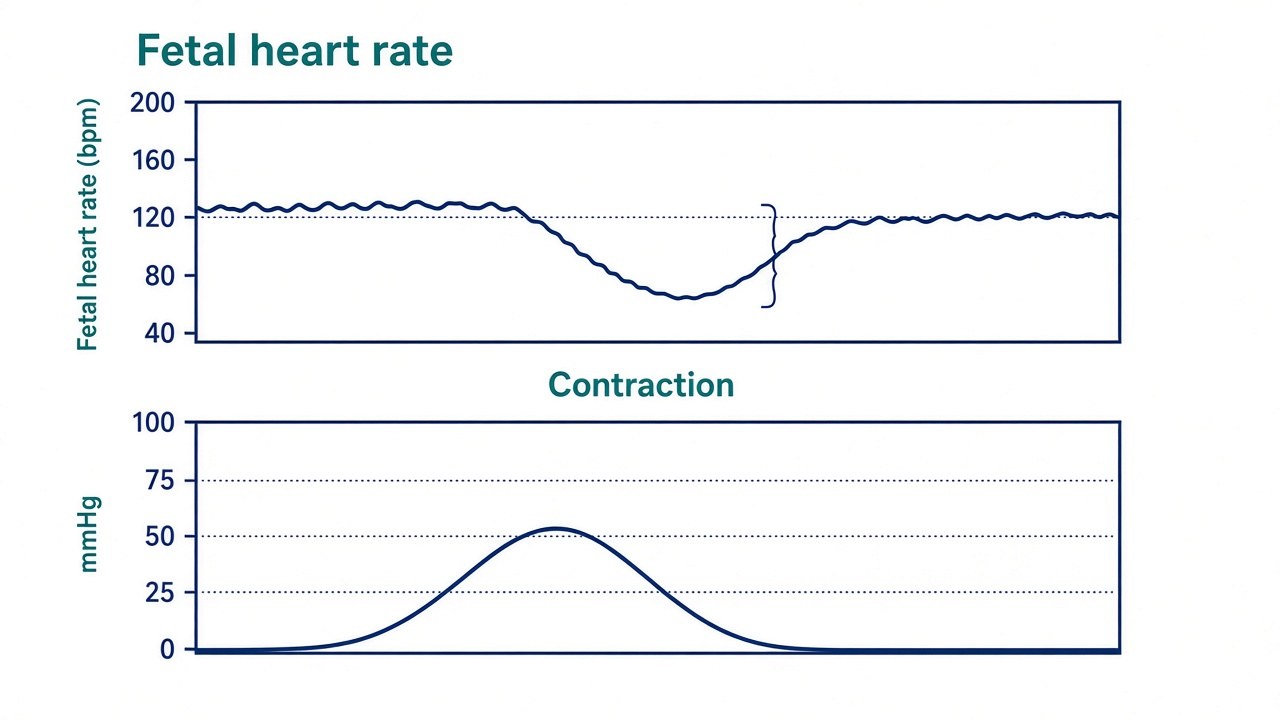
During labor, the fetal heart rate drops to 90 and stays low after the contraction ends. What does the nurse do first?
- A. Document it after delivery.
- B. Reposition the client, often to a side, give oxygen if ordered, and notify the provider.
- C. Start discharge instructions.
- D. Give juice and recheck in an hour.
Answer: B.
A fetal heart rate of 90 that remains low after the contraction is over is not a brief dip that recovers with the contraction. The immediate nursing actions improve blood flow to the placenta: turn the client, often off the back and onto a side, apply oxygen if the order or protocol allows, and call the provider while you stay. Choice A waits until the baby is born, which is the outcome you are trying to protect. Choice C is teaching for a client who is going home. Choice D delays an hour for a snack. Intrauterine resuscitation is a set of actions you start while help is coming. Charting happens, but it is not the first action, and it is not delayed until after delivery.
-
A client says, “Everyone would be better if I were gone.” What is the best response?
- A. “You should not think that way.”
- B. “Are you thinking about killing yourself?”
- C. “Let’s talk about the weather.”
- D. “Other clients have it worse.”
Answer: B.
The sentence is a possible wish to die. The assessment is a direct question about suicide, asked in plain words, followed by staying with the client and getting help if the answer is yes. Choice A scolds the thought and tells you nothing about whether there is a plan. Choice C changes the subject, which the client can hear as a refusal to listen. Choice D compares suffering and can increase shame. Asking the question does not plant the idea. Clients who are thinking about suicide are often relieved that someone named it. After the direct question, do not leave the client alone while you go find the team.
-
The nurse has a new client with chest pain and a stable client who needs a bath. Which action is correct?
- A. Finish the bath first so the assignment stays in order.
- B. See the client with chest pain first.
- C. Ask the new client to wait until after lunch.
- D. Ask the unit secretary to assess the chest pain.
Answer: B.
New chest pain can be ischemia, and the client has not been seen. That outranks a bath for a client who is described as stable. Choice A protects the order of the assignment instead of the unstable person. Choice C adds hours of delay to a symptom that can change in minutes. Choice D hands an assessment to a secretary, whose job is not physical assessment. You can ask assistive personnel to start or delay the bath. You cannot ask them to decide whether the chest pain is safe. See the chest pain, get a set of vital signs, and call for help if the pain is ongoing.
-
A client using patient-controlled analgesia is hard to arouse and breathing 8 times a minute. What is the priority?
- A. Teach incentive spirometry.
- B. Stay with the client, support breathing, and get help.
- C. Increase the analgesia dose.
- D. Leave to finish the medication pass.
Answer: B.
Opioids depress the drive to breathe. Eight breaths a minute and a client who is hard to arouse are oversedation, not a successful pain plan. Stay, stimulate the client, support the airway and breathing, and call for help. Many orders include naloxone for this situation, but you do not leave the client to go hunt the rest of the medication pass. Choice A is postoperative teaching for a client who is awake. Choice C adds more opioid to a client who is already not breathing enough. Choice D treats the nurse’s task list as more urgent than a respiratory rate of 8. A respiratory rate under 10 with poor arousal is a stop-and-stay finding.
Questions students ask
What is a HESI RN exam?
HESI RN exams are Elsevier assessments used inside registered nursing programs. Specialty exams follow courses such as fundamentals, pharmacology, maternity, pediatrics, and medical-surgical nursing. An exit exam is often given near the end of the program.
Is the HESI RN exit exam the NCLEX-RN?
No. The exit exam is a school readiness check. The NCLEX-RN is the licensure exam. Programs may require a HESI benchmark before they clear a student to test, and that benchmark is local policy.
How should I read a HESI score?
HESI reports a score for the version you took. Faculties often publish the number they expect in the student handbook. Treat that handbook number as the target, not a figure copied from another school.
Where do I practice HESI RN subjects?
Use the HESI RN exam catalog for original sets in fundamentals, medical-surgical nursing, pharmacology, mental health, maternity, and the exit group. Items are written by Nursing Elites and are not Elsevier forms.