
PN licensure
What is the NCLEX-PN?
The NCLEX-PN is the licensure exam for practical and vocational nurses. Like the RN exam, it is computerized and adaptive, it runs from 85 to 150 questions, and it gives you five hours. The test plan is written for the practical nursing scope, and the largest share of items is coordinated care.

NCSBN develops the NCLEX-PN. A board of nursing uses a passing result when it considers a practical or vocational nursing license. Graduation from an approved PN program is a separate requirement. So is the application, the fee, and any background check the board lists. The exam is the clinical-judgment piece of that file, not the whole file.
Nursing Elites is independent of NCSBN. The NCLEX-PN catalog is original practice written to the practical-nursing client needs. It is not a released NCLEX form.
Practical nursing, not a shorter RN exam
If you are finishing a practical or vocational program, this is your licensure exam. If you are in a registered nursing program, you want the NCLEX-RN guide. The two exams share a delivery system and a passing logic. They do not share a job description. Practicing RN delegation items will teach you to take an action your PN item wanted you to report.
Candidates who were trained outside the United States follow the same exam once a board allows them to test. The eligibility decision is the board’s. This page does not grant eligibility.
The appointment looks like the RN appointment
You will see at least 85 questions. The exam will not go past 150. Fifteen items are unscored pretest questions mixed into the form. The computer chooses later scored items from your performance and from the test plan. The exam can stop early when your result is clear, or it can run long when your result sits near the passing standard. Stopping at 85 is not a coded message you can interpret in the parking lot.
The clock is five hours, tutorial included. Optional breaks are offered after about two hours and after about three and a half hours. Take the first one if you are still going. Fatigue causes more scope errors than a hard question does.
Coordinated care is the PN version of management
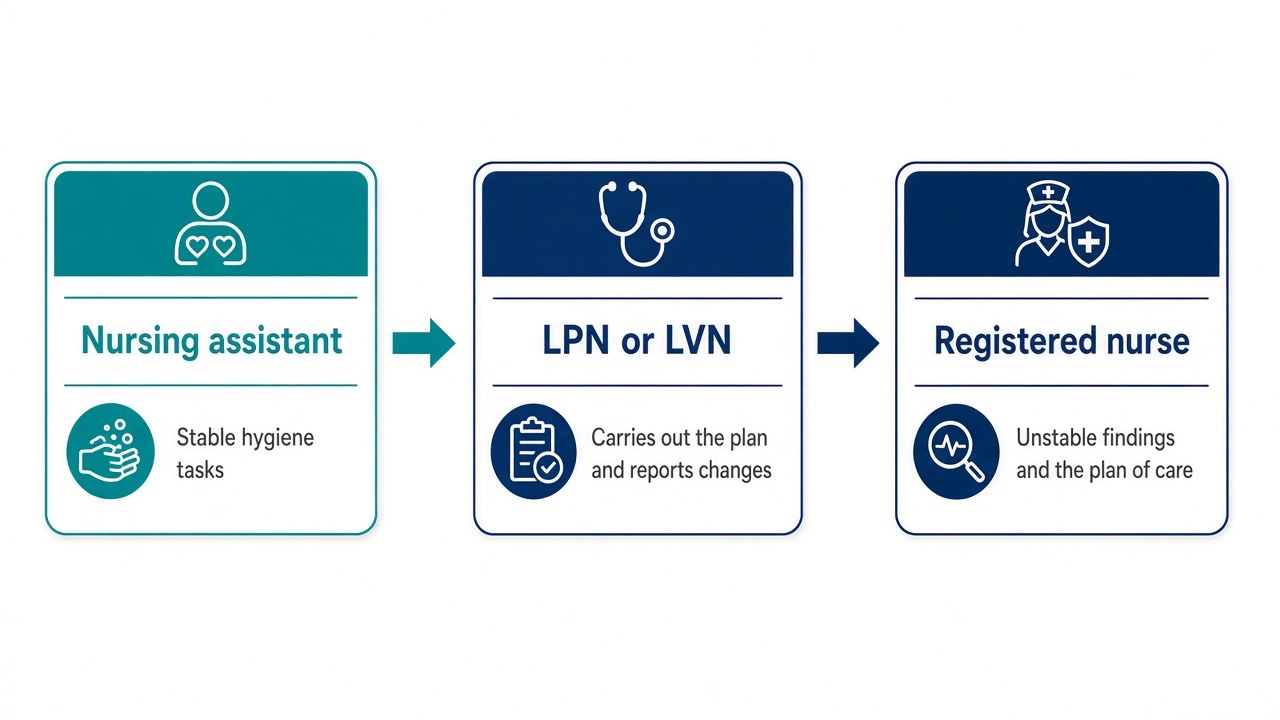
On the RN plan, the large leadership category is called management of care. On the PN plan it is coordinated care, and it is an even larger share of the exam. The work is assigning and monitoring care within the PN role, respecting the care plan the RN or the provider established, advocating for the client, and keeping confidentiality. You coordinate. You do not independently rewrite the plan for an unstable client.
A useful check on any item: Is this patient stable, is this task inside my job, and do I already have an order or a plan that covers it? If the finding is new or the patient is slipping, the next PN action is often to stay, to make the scene safe, and to notify the RN. That sequence is the content. It is not a timid guess.
The published ranges
NCSBN publishes ranges rather than a fixed count, because each candidate receives a sample of the plan. These are the current PN ranges.
NCLEX-PN client-needs ranges
Safety covers infection control and accident prevention. Health promotion covers growth through older adulthood and prevention teaching a PN is expected to reinforce. Psychosocial integrity is a larger share than on the RN plan, so therapeutic communication and mental-health basics are not optional. Basic care is the daily work: comfort, mobility, nutrition, hygiene. Pharmacology is administration and observation for effect or harm, inside the PN role. Reduction of risk is tests and potential complications. Physiological adaptation is the illness content you can be expected to recognize and report.
The catalog uses the four broad groups: safe and effective care environment, health promotion, psychosocial integrity, and physiological integrity. Coordinated care and safety both live under safe and effective care. If psychosocial sets are the ones you avoid, start there. They are a larger piece of this exam than most students expect.
Cases, not only single questions
The PN exam uses the Next Generation styles as well: multiple response, bow-tie, trend, matrix, highlight, cloze, and ordered response, plus ordinary multiple choice. On a trend item, decide what is different from the last time you saw the patient. On a bow-tie, the actions have to match the problem you named. A correct action for a different problem does not score.
Select-all-that-apply items have no partial comfort if you are guessing in both directions. Include an option only when you can defend it. Leave it out when you are hoping.
The report you get if you do not pass
A pass is a pass. A fail comes with a candidate performance report that places you relative to the passing standard in the test-plan areas. Rebuild the next attempt from the areas marked below the standard, with extra weight on coordinated care if that is one of them. The retake interval is published by NCSBN and applied by the board. Do not schedule from memory.
School exit exams from HESI LPN or ATI LPN can point at the same weak course. They cannot tell you that you are “basically passing” the NCLEX-PN. Different scoring, different standard.
Nursing Elites does not guarantee a pass or a practical nursing license. Read the current NCLEX candidate bulletin and your board’s application instructions before you book a date.
How to divide the month
Give coordinated care and pharmacology the most sessions. Add safety to both, because an infection-control miss often hides inside a care-assignment item. Use psychosocial sets on days when you are tempted to cram adult disease, so that category does not arrive on test day as a surprise. End the week with a mixed set. During review, say the scope check out loud once. If you cannot say why the RN-level option is wrong, you do not own the item yet.
Related reading
- NCLEX-PN practice catalogClient-needs sets for the practical nursing plan.
- How to pass the NCLEXPreparation habits that apply once your date is set.
- HESI LPN guideThe in-school exit exam that comes before this one.
- NCLEX-RN guideRead this only if the license you want is RN.
- How to become a nurseWhere the PN license sits in the longer career.
Official sources
The ranges in the chart are the 2023 NCLEX-PN Test Plan. Appointment rules are on NCLEX.com.
Five NCLEX-PN-style practice items
The credited choice is the practical-nursing action. These items are original.
-
Which task fits coordinated care for an LPN?
- A. Writing the first plan of care for a new unstable client.
- B. Following the established plan and reporting a new abnormal finding to the RN.
- C. Diagnosing a new medical condition.
- D. Prescribing a stronger pain medication.
Answer: B.
Coordinated care is the practical nurse carrying out a plan that already exists and sending new information to the RN when the client changes. Choice B is that job. Choice A is the initial plan for a client who is unstable, which the RN develops. Choice C is a medical diagnosis, which is not a nursing license at either level. Choice D is prescribing, which belongs to a provider. The attractive wrong answers all sound helpful. Helpful is not the same as inside the role. If the stem says the plan is already written and the finding is new, the PN action is to follow the plan and report the change, not to rewrite the plan or name a disease.
-
A client is on contact precautions for a draining wound. The door sign and the equipment order match the figure. Which action is correct?
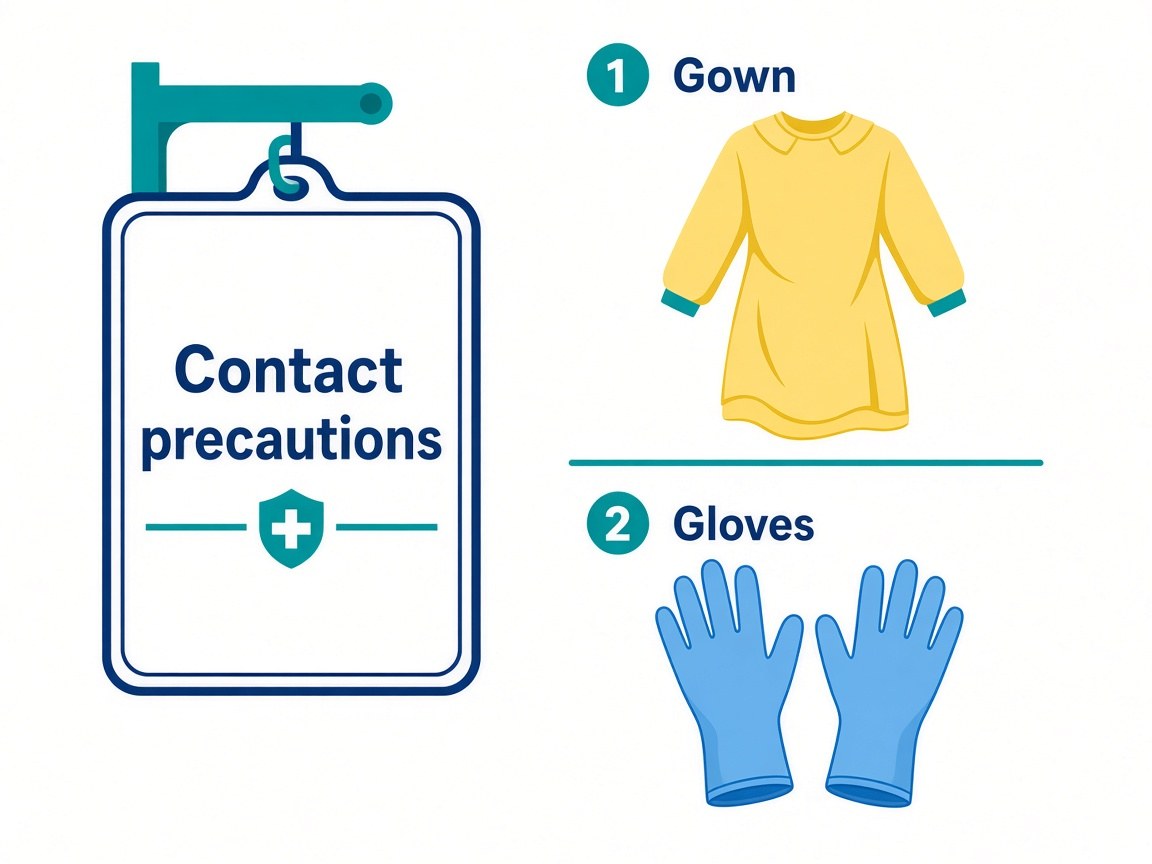
The sign is the precaution. The numbered steps are the order for putting the equipment on before you touch the client or the wound. - A. Put on the gown, then the gloves, before contact with the client.
- B. Prop the door open so meals arrive faster.
- C. Keep the same gloves on in the hallway.
- D. Set soiled linen on a chair in the hall.
Answer: A.
Contact precautions are used when organisms can be picked up from the client or the environment by touch. The gown protects your clothing, and the gloves go on after the gown so the cuffs are covered. That is the order in the figure, and it is the action that matches the sign. Choice B holds the door open and lets other people brush past a room that was meant to be a barrier. Choice C takes gloves that have touched the wound into the hall, which moves the organism onto rails and charts. Choice D parks soiled linen where the next person will touch it. Equipment comes off before you leave the room, and linen goes into the designated bag, not onto furniture.
-
Before a blood-pressure medication, the reading is 88/52. What is the appropriate action?
- A. Give the dose so the schedule stays exact.
- B. Hold the dose and notify the RN of the low reading.
- C. Ask the client to stand quickly, then recheck.
- D. Document the dose as given and move to the next room.
Answer: B.
A blood pressure of 88/52 is low. A medication ordered to lower blood pressure can drop it further, which is how clients faint or lose perfusion to the brain and kidneys. The practical-nursing action is to hold the dose and tell the RN the reading, the client’s position, and how the client feels. Choice A protects the clock instead of the pressure. Choice C asks a client with a low pressure to stand, which can drop the pressure again and cause a fall. Recheck lying or sitting if you need a second reading. Choice D charts a dose that was not given, which is a false record. Parameters differ by order, but a pressure already this low is not a “give it and watch” finding.
-
A client says, “I do not want to live like this anymore,” and will not make eye contact. What should the PN do?
- A. Change the subject to lunch.
- B. Ask if the client is thinking about suicide, stay, and get the RN.
- C. Tell the client to cheer up.
- D. Promise not to tell anyone what was said.
Answer: B.
The words are a possible wish to die, and the lost eye contact does not make them less serious. Ask a direct question: are you thinking about suicide? Stay with the client. Tell the RN. Do not leave to finish a task while the client is alone with that statement. Choice A offers lunch and skips the assessment. Choice C tells the client the feeling is unwelcome. Choice D promises secrecy. You cannot keep a safety statement secret from the nurse who is responsible for the plan. Say that you have to share it so the client can be kept safe. Asking does not cause the suicidal thought. It finds out whether there is a plan.
-
A weak client asks to walk to the bathroom. What is the safest action?
- A. Tell the client to go alone to build strength.
- B. Assist the client, using the support the plan calls for.
- C. Leave the client standing while you answer another call light.
- D. Ban all walking for the rest of the stay.
Answer: B.
Weakness plus a walk to the bathroom is a fall setup if the client goes alone. The safe action is to help, with the gait belt, walker, or second person the plan already names. Choice A calls unsupervised walking “strength building.” Strength is built when the client is supported, not when the client is left to fall. Choice C is how falls happen in doorways: the client is upright, tired, and unattended. Choice D is the other extreme. A weak client still needs to walk when the plan says walking is allowed. The decision is the amount of help, not a ban and not a dare. If the plan does not say the client may walk, you report the request instead of inventing either extreme.
Questions students ask
What is the NCLEX-PN?
The NCLEX-PN is the National Council Licensure Examination for Practical Nurses, delivered by NCSBN. A passing result is one requirement state boards use before they issue a practical or vocational nursing license.
How many questions are on the NCLEX-PN?
The current exam uses computerized adaptive testing. The length runs from 85 to 150 questions. Fifteen of those items are unscored pretest questions. The exam stops when the scoring rule is met or when the time or item limit is reached.
How long do I have for the NCLEX-PN?
The maximum appointment is five hours. That clock includes the tutorial and any breaks you take. Optional breaks are offered after about two hours and again after about three and a half hours.
What is a passing NCLEX-PN score?
The result is pass or fail. It is not a percentage. Candidates who do not pass receive a candidate performance report that compares performance with the passing standard in the test-plan areas.