
RN licensure
What is the NCLEX-RN?
The NCLEX-RN is the national licensure exam for registered nurses. It is a computerized adaptive test. You will answer at least 85 questions and no more than 150, inside a five-hour appointment. The result is pass or fail, not a percent.

The National Council of State Boards of Nursing writes the NCLEX-RN. A state or territorial board of nursing uses a passing result, along with graduation from an approved program and the rest of its application, when it issues an RN license. Nursing Elites does not give the exam, does not see your result, and is not affiliated with NCSBN.
The current test plan, including the Next Generation item types, has been in use since April 2023. If you are reading an outline from before that date, the client-needs names may look familiar and the item types will be incomplete.
A license decision, not a course grade
Faculty exams sort a class. The NCLEX-RN sorts a candidate against a passing standard for safe care as a newly licensed registered nurse. You are not competing with the person at the next carrel. Their exam is built from their answers, and yours is built from yours. A longer exam is not a fail. A shorter exam is not a pass. Length means the scoring rule has enough information, or that you reached the time or the item limit.
What “adaptive” means on this test
Each scored item is chosen from the test plan with your running estimate in mind. After a correct response, the next item tends to be more difficult. After a miss, it tends to be less difficult. Fifteen pretest items are mixed in. They do not affect the result, and you cannot spot them. Answer every item as if it counts.
The exam can stop at 85 items if the pattern of answers is clearly above or clearly below the passing standard. It can continue toward 150 if the estimate stays close to the line. If time runs out, the decision uses the answers you completed, under the rule NCSBN publishes in the candidate bulletin. Do not try to steer the length. You cannot see the estimate.
That is also why a percent from a practice bank is a weak prediction. A practice bank does not adapt, and it does not apply the passing standard. Use practice to find the content you cannot explain. Use the candidate bulletin for the rules of the real appointment.
The item types you should rehearse
Multiple-choice items with one best answer are still there. So are select-all-that-apply items, where each option is its own true or false decision. Since 2023 you should also be ready for case-based items that share a patient chart:
- Bow-tie items, which ask you to connect a condition, the actions you take, and the findings you expect if the actions work
- Trend items, which add information across time and ask what changed
- Matrix or grid items, which ask you to mark several judgments in a table
- Highlight and cloze items, which ask you to choose words, numbers, or findings inside a note
- Drag-and-drop and drop-down items, which ask for order or for the phrase that completes a statement
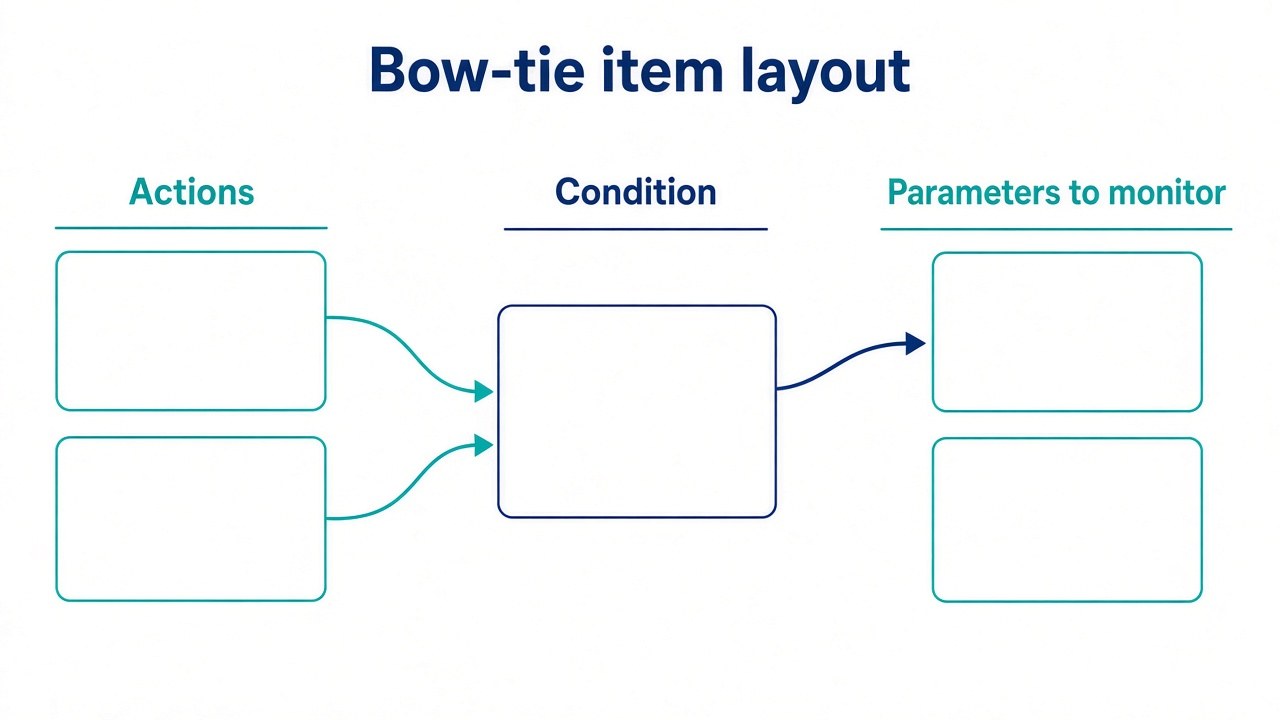
On a case, read the question before you read the whole chart. Then take only the rows that the question needs: the vital signs, the new lab, the medication list. A chart is long on purpose. The credited response uses the relevant change, not every abnormal number.
Where the items come from
The RN test plan groups content as client needs. NCSBN publishes a range for each area, because every candidate’s form is a sample, not a fixed quiz. These are the ranges from the current plan.
NCLEX-RN client-needs ranges
Management of care is delegation, priority, advocacy, and legal duties of the RN. Safety is infection prevention, error prevention, and emergency response. Health promotion is growth, prevention, and screening. Psychosocial integrity is coping, therapeutic communication, and mental health. Basic care is comfort, hygiene, mobility, and rest. Pharmacology is effects, adverse effects, and administration. Reduction of risk is diagnostic tests and the complications you are trying to prevent. Physiological adaptation is the body’s response to acute and chronic illness, and the care that follows.
The NCLEX-RN catalog is grouped by those same client needs: safe and effective care, health promotion, psychosocial integrity, and physiological integrity. There is also a second health-promotion label in the catalog from an older spelling. Use either health-promotion set. The content is the client need, not the spelling.
Time, breaks, and the result
The appointment is five hours, including the tutorial and the breaks you accept. Optional breaks come after about two hours and again after about three and a half hours. The clock does not stop because you stood up, so decide in advance that you will take the first break if you are still testing. Bring identification that matches the registration. Leave study notes outside.
A pass does not arrive as a number you can post. A fail arrives with a candidate performance report that shows whether you were above, near, or below the standard in the test-plan areas. That report is the study plan for the next attempt. The waiting period before a retake is set by NCSBN and by the board, and it is in the bulletin, not in a forum guess.
Use school exams as a map, then leave them
An ATI RN predictor or a HESI RN exit exam can show that maternity or pharmacology is thin. That is useful. Those exams still end in a course-style score. The NCLEX-RN ends in a standard. Once you know the weak area, practice it in NCLEX items, including cases that make you update a decision when a new vital sign arrives. Do not keep sitting the same exit form until its percent feels lucky.
Nothing on Nursing Elites guarantees a passing NCLEX-RN result or a license. The board of nursing is the licensing authority. NCSBN is the examination authority.
A simple rotation
Spend more days on management of care and pharmacology than on the smaller ranges, because that is where more items live. Inside each day, mix one standalone item set with one case. After a miss, classify it before you reread the chapter: unknown fact, right fact but wrong priority, or a misread of the chart. Only the first of those is solved by more reading. The other two are solved by slowing the last line of the stem.
Related reading
- NCLEX-RN practice catalogSets arranged by the four client-needs groups.
- How to pass the NCLEXStudy habits once the test date is real.
- NCLEX-PN guideThe practical-nurse exam, if that is the license you are seeking.
- ATI RN guideIn-school exams that are often mistaken for the NCLEX.
- Compact nursing statesWhat a multistate license can mean after you pass.
Official sources
The ranges in the chart are the 2023 NCLEX-RN Test Plan, effective April 2023. Candidate rules live on NCLEX.com.
- 2023 NCLEX-RN Test Plan (PDF).
- NCLEX.com, for registration, the candidate bulletin, and exam-day rules.
Five NCLEX-RN-style practice items
These are original items written to the client-needs plan. A practice percent on this page is not an NCLEX result.
-
Which client does the nurse see first?
- A. A client who wants a scheduled pain pill that is already due.
- B. A client with a new, sudden drop in level of consciousness.
- C. A client who wants the discharge papers explained again.
- D. A client who needs a routine dressing change.
Answer: B.
A sudden drop in consciousness can be a failing airway, a fall in blood glucose, a stroke, or rising pressure inside the skull. You do not know which until you are at the bedside, so this client is first. Choice A is real pain and a due dose, and it is next, not first, because the client is described as asking rather than as unstable. Choice C is teaching that can be repeated. Choice D is a scheduled dressing on a client who is not described as bleeding or infected. Priority is not “who asked first.” It is whose condition can change in the minutes you spend elsewhere. After you see the client with the new deficit, you can give the pain dose or ask another nurse to start it.
-
Which action breaks the chain of infection?
- A. Recapping a used needle with both hands.
- B. Cleaning hands before and after client contact.
- C. Reusing a blood-pressure cuff that is visibly soiled with blood.
- D. Wearing the same gloves from room to room.
Answer: B.
The chain of infection needs an organism, a reservoir, a way out, a way to travel, a way in, and a susceptible host. Hand hygiene cuts the travel step between clients and between tasks. Choice A, recapping a used needle with two hands, is how needlestick injuries happen. Needles go into a sharps container uncapped, or they are covered with a one-handed scoop only if no container is immediately there and policy allows it. Choice C moves blood from one client’s skin to the next client’s arm. Choice D turns gloves into a transport system. Gloves are changed, and hands are cleaned, between rooms. The correct action is the one that interrupts transfer. The other three create it.
-
A client taking lisinopril reports a dry cough and swelling of the lips. Which finding is an emergency?
- A. The dry cough, reported at the next routine visit.
- B. Swelling of the lips.
- C. A request for a low-salt recipe.
- D. A blood pressure of 128/76 with no other symptoms.
Answer: B.
Lisinopril is an ACE inhibitor. A dry cough is a known effect and should be reported, but it is not the emergency in this list. Swelling of the lips, tongue, or face is angioedema. The airway can close, so this client needs assessment and treatment now, and the drug is not given again until a provider says otherwise. Choice A delays a non-emergency symptom to a routine visit, which is reasonable for the cough alone. Choice C is diet teaching and has nothing to do with the drug reaction. Choice D is a blood pressure many clients are trying to reach, and the stem gives no other symptom with it. When an item lists two effects of the same drug, separate the nuisance effect from the effect that threatens the airway.
-
The clipboard is this client’s weight log. The client has chronic heart failure and is more short of breath this morning. What does the nurse do?
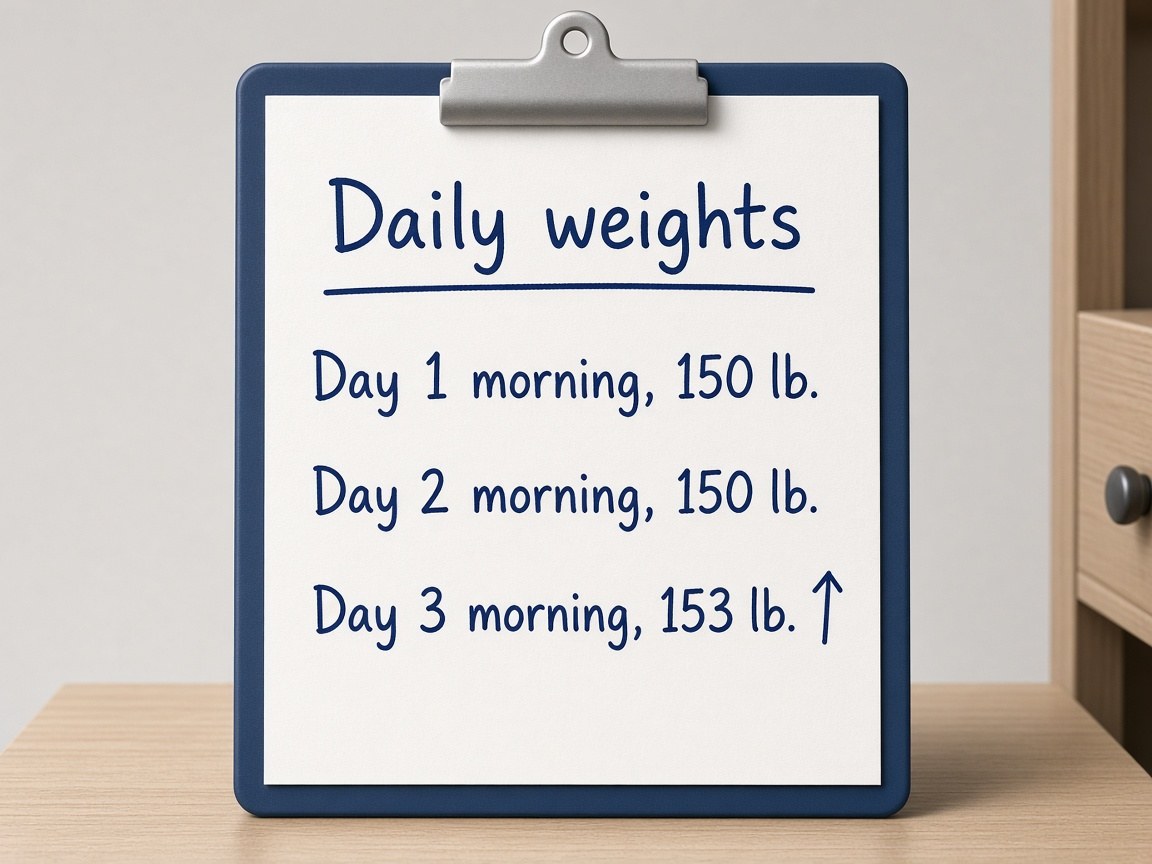
The gain is 3 pounds from day 2 to day 3, overnight on a morning scale. The client is also more short of breath. - A. Tell the client a 3-pound change is too small to mention.
- B. Assess breathing and report the 3-pound gain together with the new shortness of breath.
- C. Encourage a high-sodium meal so the client will eat.
- D. Stop all heart-failure medications without an order.
Answer: B.
The log is flat at 150 pounds and then 153 pounds the next morning. Three pounds overnight is fluid until proved otherwise, because fat is not gained that fast. Shortness of breath on the same morning fits fluid backing up into the lungs. Assess the breathing, the oxygen saturation, and the lung sounds, and report the weight and the breathing change together. Choice A uses a cutoff some clients are taught for a slower gain, such as 3 pounds in a week, and applies it to an overnight jump. Choice C adds sodium, which holds more fluid. Choice D stops medications, including the diuretic that may be the treatment, with no order. The two findings are one story. Report them as one story.
-
Which checks belong before a medication dose? More than one answer is correct.
- A. Two client identifiers, compared with the record.
- B. The medication, dose, and route compared with the order.
- C. A roommate’s opinion of the dose.
- D. The allergy list, compared with the drug.
Answer: A, B, and D.
Before a dose, the nurse confirms who the client is, using two identifiers matched to the record, confirms that the drug, dose, and route match the order, and confirms that the allergy list does not include this drug or a related one. Those are choices A, B, and D. Choice C brings in a roommate, who is not a source for identity, for the order, or for allergies. Select-all items are graded as a set of true-or-false decisions. A choice can sound friendly and still be false. Do not add C because an extra check “cannot hurt.” An extra person who is not part of the record is not a check.
Questions students ask
What is the NCLEX-RN?
The NCLEX-RN is the National Council Licensure Examination for Registered Nurses. NCSBN develops it. State and territorial boards of nursing use a passing result as part of the decision to issue an RN license.
How many questions are on the NCLEX-RN?
You will see at least 85 questions and no more than 150. Fifteen items are unscored pretest questions mixed into the exam. Because the test is adaptive, two candidates can finish with different lengths and still receive a fair pass or fail decision.
What changed with the Next Generation NCLEX?
Since April 2023 the RN exam has included case-based item types that ask for clinical judgment, such as bow-tie, trend, matrix, highlight, and cloze items, along with familiar multiple-choice and select-all-that-apply items.
Can a school exam guarantee that I will pass the NCLEX-RN?
No. Predictor and exit exams estimate readiness. Only the NCLEX-RN result, together with the other requirements of the board of nursing, leads to licensure. Nursing Elites does not guarantee a score or a license.