
Nursing school admission
What is the HESI A2?
The HESI A2 is Elsevier’s Admission Assessment. Unlike the TEAS, it is not one fixed four-part test. Your school chooses the academic sections you must pass before a nursing program will read the rest of your application.

HESI stands for Health Education Systems, Inc., and the A2 is the exam applicants meet before classes start. A candidate at one college may sit for math, reading, vocabulary, grammar, and anatomy. A candidate at another may add biology and chemistry and skip physics. Comparing raw “I got an 82” stories is useless until you know which sections produced the 82.
Nursing Elites is independent of Elsevier. Nothing in the HESI A2 practice catalog is a leaked or retired HESI form. The sets rehearse the same academic subjects schools assign.
Start with the section list, not a national outline
Open the admission page and write down the required sections, the minimum on each, the cumulative rule if there is one, and the retake gap. That list is your syllabus. If the page is vague, email the nursing advisor and ask which HESI A2 exams are required for the term you want. Do this before you buy a review that spends a third of its pages on chemistry you will never see.
Time and length follow the sections you are given. A full battery is a long morning. A three-section requirement is a different appointment. Budget from the confirmation email, not from a forum post about a different campus.
Math
HESI math is applied arithmetic: whole numbers, fractions, decimals, ratio and proportion, household and metric conversion, and roman numerals on dosage labels. The work looks simple and then punishes a unit error. Write the unit beside every number. If the item gives milliliters and asks for liters, the conversion is the question. A calculator policy is set by the testing site. Practice both with and without one so a mental estimate can catch a wrong key.
The catalog’s HESI A2 math sets are the right rehearsal for this block. Metric items also show up inside anatomy and chemistry when those sections are required, so do not treat conversion as a one-afternoon topic.
Reading comprehension
Passages are informational. You will identify the main idea, a supporting detail, a word in context, and the author’s purpose. Some items ask what a later paragraph would logically do. The skill is the same one you need on the ATI TEAS 7 reading section, but the HESI passages and the way the questions are grouped are their own style. Practice on HESI reading sets if HESI is the exam you will sit.
When two answers look true, choose the one the passage actually supports. Outside knowledge about health care can talk you into an option the paragraph never said.
Vocabulary and grammar
Vocabulary on the A2 is general academic English plus the medical terms a new student can be expected to break apart. Prefixes, suffixes, and roots will get you through more items than a memorized list of rare diseases. If a word is long, split it before you guess.
Grammar items look at agreement, pronoun reference, commonly confused words, and sentence parts. The question is usually “which choice is best,” and the best choice is the one that is both correct and clear. A fancy word that breaks agreement is still wrong.
Biology, chemistry, and anatomy
These are separate sections when the school assigns them. Biology covers cells, metabolism, genetics, and basic biological molecules. Chemistry covers atomic structure, the periodic table at a beginner’s level, bonding, equations, solutions, and acids and bases. Anatomy and physiology covers the body systems and the terms that describe position and direction. You can be fluent in anatomy and still miss chemistry, which is why a single “science” score from a TEAS report does not map onto a HESI science day.
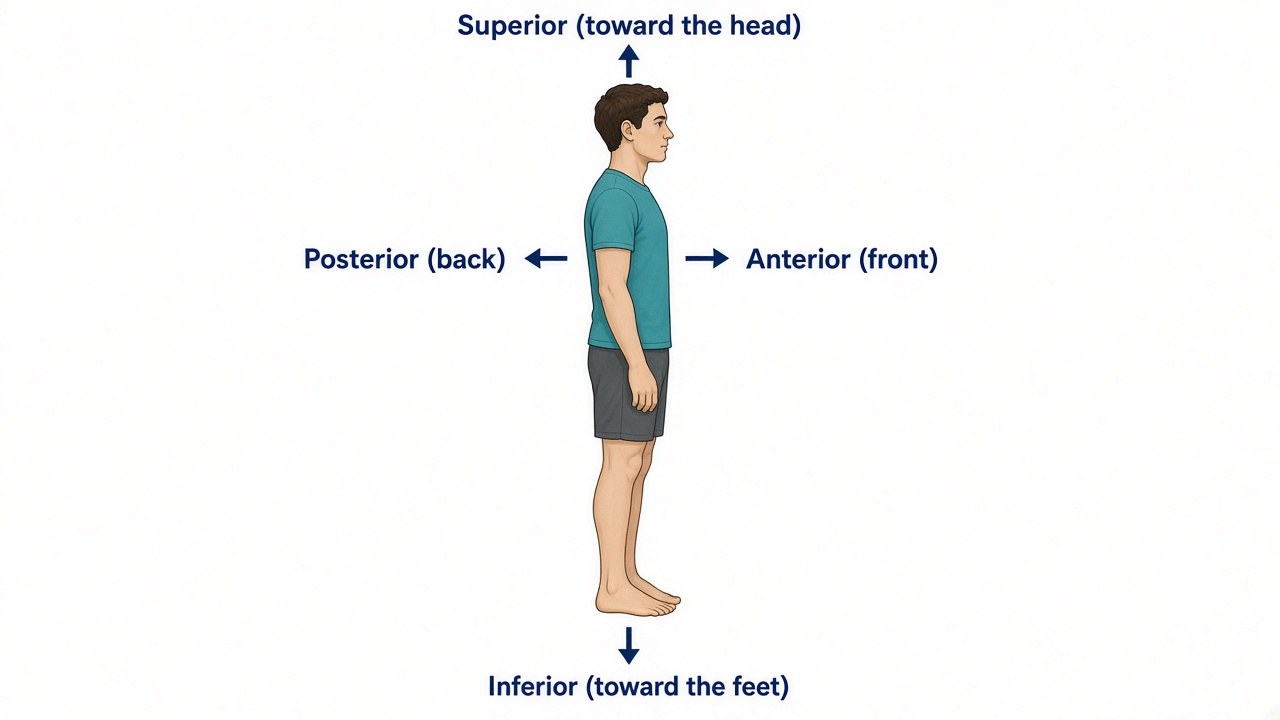
Study anatomy by system, in speech you could give to a classmate: what the organ does, what it connects to, and which word in the item names that job. For chemistry, know the difference between a mixture and a compound, and what dilution does to concentration. For biology, be able to follow a trait across one generation without turning the item into a Punnett-square performance.
Physics appears on some A2 menus and on few nursing checklists. Confirm it. Critical thinking, when assigned, is its own section and should be practiced only if your letter says so. The catalog includes a critical-thinking set for that case, not as a default for every applicant.
Learning style and personality items
Some schools add an inventory of how you like to study or a personality profile. These results describe preferences. They are not academic scores, and most programs do not use them as the admission cutoff. Complete them honestly if they are on your appointment. Do not spend your anatomy week trying to “win” a learning-style label.
How a HESI A2 score is read
Each academic section produces a score. Many reports show that score from 0 to 100, and a cumulative figure built from the sections you took. The cumulative is only meaningful for the same section mix. An 80 on math, reading, and vocabulary is not the same achievement as an 80 that also includes anatomy and chemistry.
Schools print the minimum they want. Some require every section to clear a line. Some allow a strong section to offset a weaker one, and some do not. Retakes may replace the old score, average with it, or count only if a waiting period has passed. That rule is local. Ask before you retest, because a second score can hurt under a policy you did not read.
Nursing Elites does not set, predict, or guarantee a HESI A2 result. The school’s admission office is the only source for the cutoff that applies to you.
Do not study the exit exam by mistake
Later in a program you may meet HESI specialty exams and a HESI exit exam. Those ask about nursing care. The A2 asks about academic readiness. If you are still applying, stay on this page and on the A2 catalog. If you are already enrolled in a registered nursing program, move to the HESI RN guide. Practical nursing students should use the HESI LPN guide.
A practical study order
Take one diagnostic set in each required section and rank them by misses, not by how you feel about the subject. Repair math conversions and grammar first if they are shaky, because those errors repeat in every later set. Then give anatomy the longest block of days. Reading improves with daily passages more than with a single weekend. Stop when you can explain a wrong answer without looking at the rationale.
Related reading
- HESI A2 practice catalogMath, reading, vocabulary, grammar, biology, chemistry, anatomy, and critical thinking.
- The HESI A2: what nobody tells youAn applicant’s account of the exam before nursing school.
- ATI TEAS 7 guideThe fixed four-section admission exam some programs use instead.
- How to become a nurseWhere an admission exam sits in the longer path.
- Associate degree in nursingMany ADN programs are the schools asking for a HESI A2 score.
HESI A2 sections a school may assign
Official sources
Your admission letter is the section list that counts. Elsevier describes the product, and Evolve is where the school’s exam opens.
- Elsevier’s HESI overview, from admission assessment through later exams.
- Evolve, the sign-in students use for the HESI course their program assigned.
Five HESI A2-style practice items
These items are original. Practice the ones that match the sections on your admission letter.
-
The label says 250 mg per tablet. The order is 500 mg. How many tablets is that?
- A. 1 tablet
- B. 2 tablets
- C. 3 tablets
- D. 4 tablets
Answer: B.
Set the proportion as desired dose divided by the dose on hand: 500 mg ÷ 250 mg per tablet = 2 tablets. The milligrams cancel, and the unit that remains is tablets. Choice A gives the label strength as if it were already the full order. Choice C is what you get if you add the two numbers and then drop a zero (500 + 250 looks nothing like 3, but 500 ÷ 250 + 1 is a slip some students make by counting the tablets and then adding one more). Choice D doubles the correct answer, which happens when the division is flipped into 250 ÷ 500 and then “fixed” by multiplying by 8. Write the units beside the numbers before you divide. If the units do not cancel to tablets, the setup is backwards.
-
The prefix “tachy-” means:
- A. Slow
- B. Fast
- C. Below
- D. Without
Answer: B.
Tachy- means fast. Tachycardia is a fast heart rate, and tachypnea is fast breathing. Choice A is brady-, as in bradycardia. Choice C is hypo-, as in hypotension, or sub-, as in subcutaneous. Choice D is a-, as in afebrile, or an-, as in anaerobic. The exam often pairs the right prefix with a familiar word and three prefixes from neighboring body-system terms. Translate the prefix before you look at the choices, then find the choice that matches your translation. If you start from a choice that “sounds medical,” brady- and tachy- are easy to swap because both describe rate.
-
Which sentence uses the word correctly?
- A. The patient is allergic too penicillin.
- B. The patient is allergic to penicillin.
- C. The patient is allergic two penicillin.
- D. The patient is allergic toe penicillin.
Answer: B.
The sentence needs the preposition “to,” which points from allergic toward penicillin. Choice A uses “too,” which means also or excessively, as in “too much.” Choice C uses “two,” the number. Choice D uses “toe,” the body part, which is a spelling neighbor and not a preposition. On a grammar item, sound-alike words are wrong even when the rest of the sentence is fine. Read the choice for the job of the word, not for whether it reminds you of the word you meant.
-
Using the diagram, the heart lies in which direction from the vertebral column?
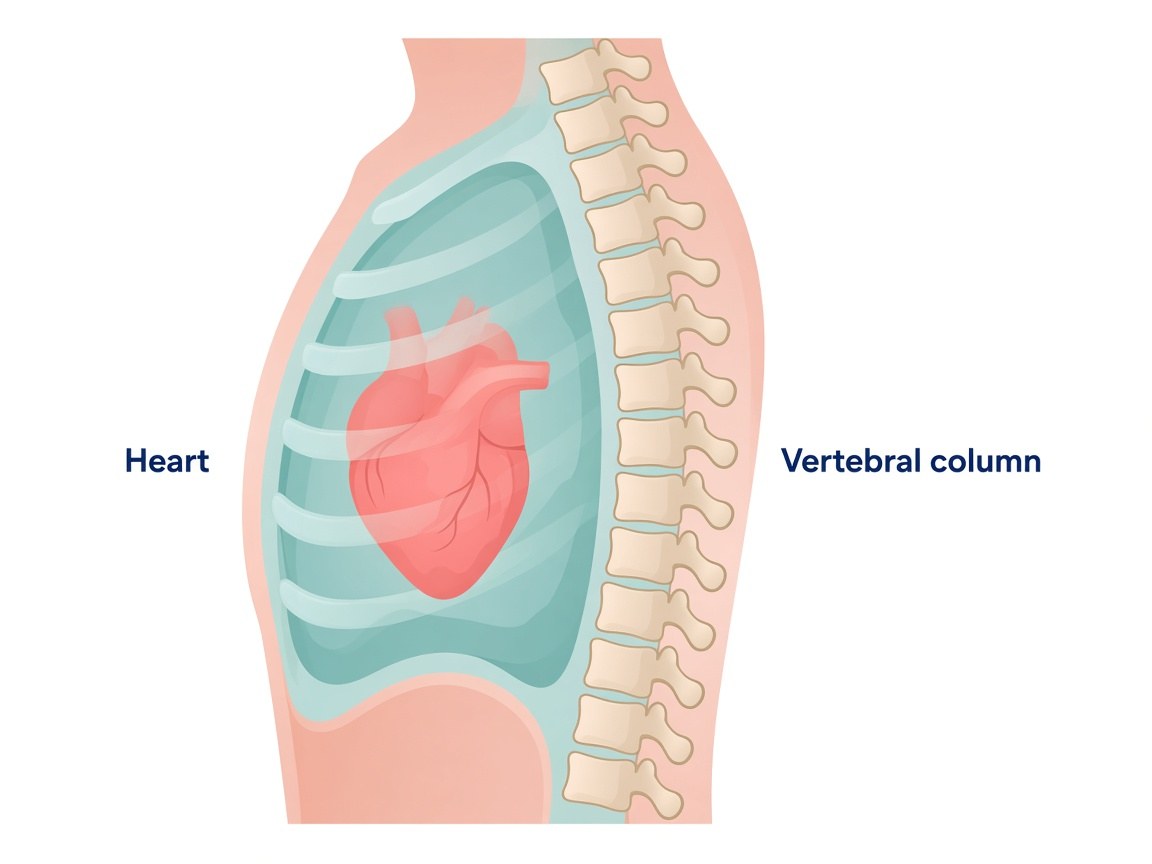
The drawing names the two structures. It does not name the direction. You supply the direction word. - A. Posterior to the vertebral column
- B. Anterior to the vertebral column
- C. Inside the vertebral canal
- D. Distal to the fingers
Answer: B.
In the side view the heart sits in the chest, toward the front of the body, and the vertebral column sits at the back. Anterior means toward the front, so the heart is anterior to the vertebral column. Choice A reverses the pair: posterior would place the heart behind the spine. Choice C puts the heart in the canal that holds the spinal cord, which is not where the drawing places it. Choice D uses “distal,” a limb word that means farther from the trunk, and the fingers are not a reference point for the heart. Direction items are about the relationship between two named structures. Name the front structure and the back structure before you pick the word.
-
A paragraph says the group that slept 7 hours scored higher than the group that slept 4 hours. What can you conclude?
- A. Sleep raises every person’s score.
- B. In this paragraph, the longer-sleep group had higher scores.
- C. Four hours of sleep is the recommendation.
- D. The study was about nutrition.
Answer: B.
The paragraph reports one comparison: the 7-hour group scored higher than the 4-hour group. That is all choice B claims. Choice A turns a group difference into a cause that works for every person, which the paragraph does not say. Choice C invents a recommendation. The paragraph never says anyone should sleep 4 hours. Choice D changes the topic to nutrition, which is not in the paragraph at all. Reading items reward the conclusion that stays inside the text. A bigger, more impressive claim is usually the trap.
Questions students ask
What is the HESI A2?
The HESI A2 is the Admission Assessment from Elsevier HESI. Schools use selected academic sections to judge whether an applicant is ready for a nursing program.
Does every HESI A2 include the same sections?
No. The school chooses the sections. A common set includes math, reading comprehension, vocabulary, grammar, biology, chemistry, and anatomy and physiology. Physics, critical thinking, learning style, and personality items appear only when that school assigns them.
How is the HESI A2 scored?
Academic sections are reported as section scores, often on a 0 to 100 scale, plus a cumulative score for the sections you took. The school, not a national cutoff, decides the minimum.
Is the HESI A2 the same exam as the HESI exit exam?
No. The A2 is an admission exam taken before the program. HESI specialty and exit exams are taken during school and near graduation. They are separate products.