
During a registered nursing program
What ATI RN exams are for
ATI RN exams are course assessments that many registered nursing programs give while you are already in school. They are not the admission TEAS, and they are not the NCLEX-RN. A program uses them to see whether a class is ready before it moves on.

Assessment Technologies Institute sells a family of proctored exams for RN curricula. Faculty choose which ones to require, when they fall in the term, and what a low score means for that course. One student may take fundamentals in the first semester and a comprehensive exam in the last. Another program may skip a subject you see listed on a study forum. The assignment in your learning-management system is the assignment that matters.
Nursing Elites is not part of ATI. The questions in the ATI RN catalog are original practice for the same subject names. They do not reproduce a proctored form.
If you have not started nursing school yet
This page is the wrong exam. Applicants are usually sent to the ATI TEAS 7 or the HESI A2. Those tests measure academic skills. ATI RN items assume you are learning nursing judgment: who you see first, which finding you report, which step keeps a patient safe. Studying RN pharmacology items will not raise a TEAS math score.
The subjects you will actually be handed
Programs build the sequence around the Content Mastery idea: a proctored check at the end of a course, sometimes a practice form before it. Names vary slightly by edition. The subjects that show up again and again, and that the Nursing Elites RN catalog is built around, are these.
- Fundamentals, including the capstone fundamentals assessment
- Pharmacology
- Adult medical-surgical nursing, plus focused sets such as cardiovascular and respiratory, gastrointestinal, endocrine, oncology, perfusion, and fluid and electrolytes
- Maternal newborn and obstetrics
- Nursing care of children
- Mental health
- Community health
- Nutrition
- Leadership and management
- Pathophysiology and anatomy, when the program still tests them as stand-alone checks
A medical-surgical exam will not repeat the whole fundamentals final, but it will assume you can still prioritize. If fundamentals was shaky, a later “harder” exam feels impossible for a simple reason: the later exam is using the earlier skill. Go back.
What a proficiency level is doing
ATI does not hand most subject exams back as a school-style percentage alone. The report places you in a proficiency level. Programs then decide what Level 1, Level 2, or a result below Level 1 means for remediation, a ticket to the next course, or a grade. Those decisions are in the student handbook. Two programs can require different levels on the same exam name.
Use the report’s topic list. A level is a summary. The misses tell you whether the problem was safety, medication effects, or a procedure you only half learned. Rewrite the misses as tasks: “state the first action when a chest-tube chamber stops tidaling,” not “review med-surg.”
Capstone, custom, and exit-style exams
Near the end of a program, faculty often add a longer exam that crosses subjects. In the catalog these show up as ATI RN capstone, custom exams, and RN exit sets. A capstone is a school milestone. An exit-style exam is a readiness check. Neither one is the license exam, and a high practice score on a predictor does not create a license.
Treat a comprehensive set as a sampling of your weak courses, not as a new subject called “everything.” If maternity items are the ones you miss, the fix is a maternity set, not another mixed exam the same night.
A way to prepare that matches how the items work
ATI-style items are short clinical stories. The last sentence is usually the question: what do you do first, which finding is unexpected, which statement shows understanding. Read that sentence before the story so you know what you are hunting. Then mark the finding that changes the decision. Extra detail in the stem is often there to slow you down.
For pharmacology, group drugs by the problem they treat and the harm they can cause, not by a brand-name list. For fundamentals, rehearse the order of a skill until the unsafe step looks obvious. For leadership items, the right answer is often the one that uses the right person: the nurse does what only the nurse can do, and delegates what a stable patient allows.
Sit at least one timed set before the proctored day. Untimed review builds knowledge. A clock shows whether you are rereading the stem until the time is gone.
The NCLEX-RN is a different test
Faculty use ATI results because the content overlaps the work of a new registered nurse. The overlap is real, and it is not identity. The NCLEX-RN is adaptive, it includes Next Generation case items, and the passing standard belongs to NCSBN. Your board of nursing, not ATI and not Nursing Elites, decides when you may test and what else the license requires.
If your program also uses Elsevier exams, read the HESI RN guide beside this one. The clinical topics rhyme. The score report does not.
Where to practice
Open the ATI RN exam catalog and pick the course you are in. Fundamentals, pharmacology, medical-surgical, maternal newborn, children, mental health, community health, nutrition, leadership, and the exit group are all separate. Read the rationale for the option you liked and for the option that was right. If you cannot say why the attractive option failed, you will choose it again.
Nursing Elites does not guarantee a proficiency level, a course grade, or an NCLEX result. Practice shows you what you can already explain.
Related reading
- ATI RN practice catalogOriginal sets arranged by the subjects programs proctor.
- NCLEX-RN guideThe licensure exam that comes after the program’s ATI checks.
- ATI LPN guideThe practical-nursing track, if you are not in an RN program.
- How long nursing school takesWhere mid-program exams sit on the calendar.
- Quality improvement for studentsThe leadership content that shows up on management items.
One way to split a week before a mixed ATI RN exam
Official sources
ATI publishes its own product and score information. The practice items below are Nursing Elites items written in the same clinical style.
- ATI Testing, the publisher of the proctored RN assessments.
- 2023 NCLEX-RN Test Plan, the licensure outline these course exams do not replace.
Five ATI RN-style practice items
Read the last line of the stem first. The answer under each item explains the action, not only the letter.
-
The monitor in the figure belongs to a client who was resting. What does the nurse do first?
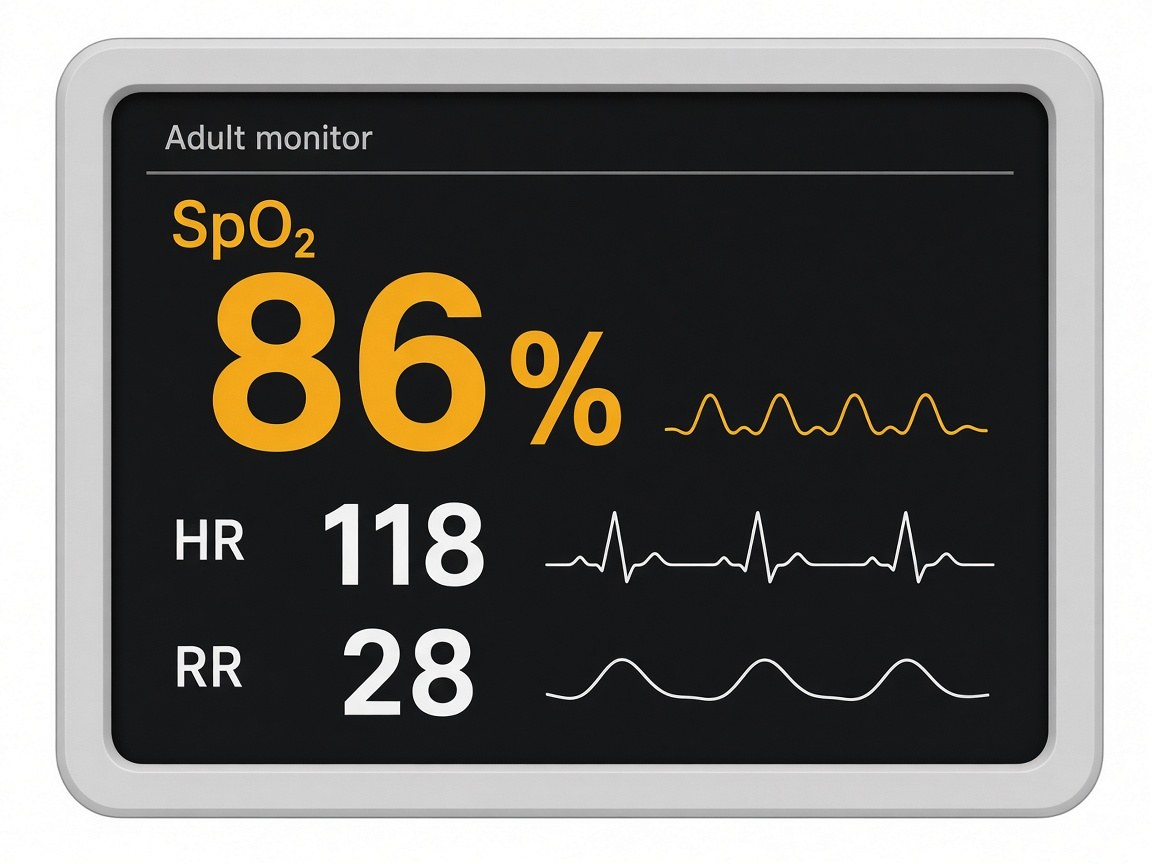
The screen is the data for the question. SpO2 86 percent, heart rate 118, and respiratory rate 28 are all abnormal at rest. - A. Document the numbers at the end of the shift.
- B. Raise the head of the bed, apply oxygen if it is ordered, stay, and reassess.
- C. Ask the family to bring a blanket.
- D. Begin smoking-cessation teaching.
Answer: B.
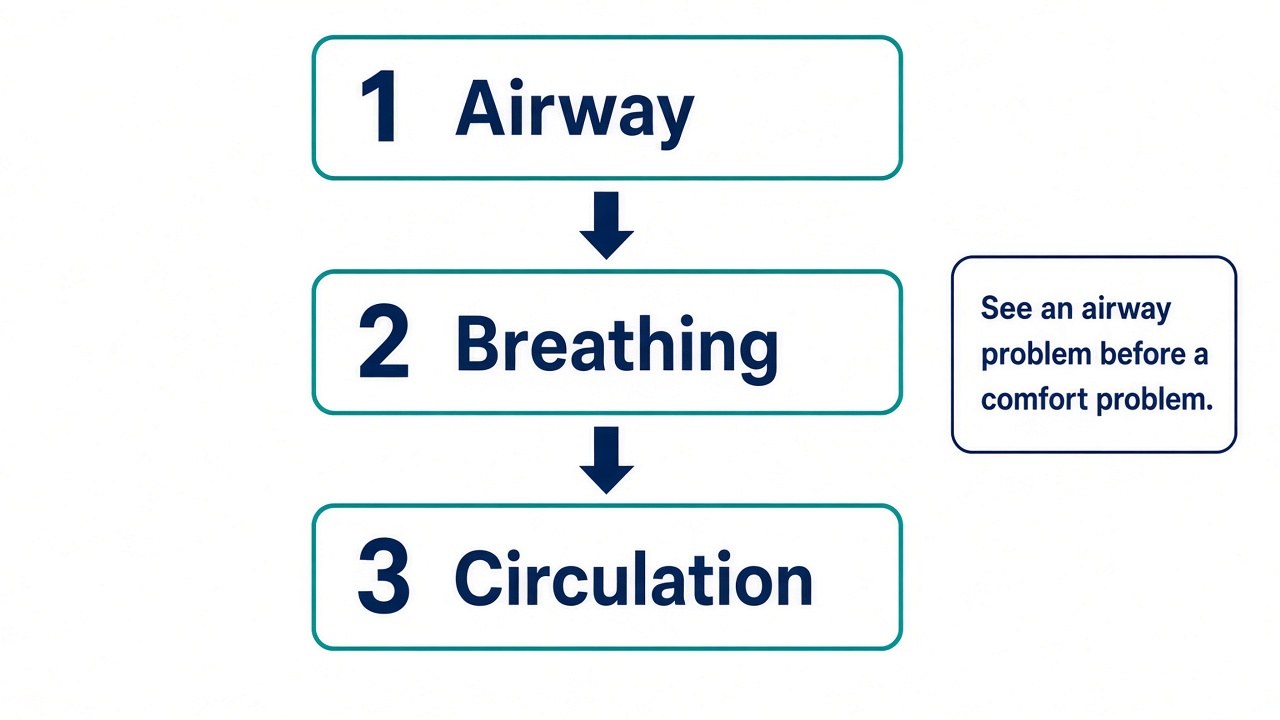
An oxygen saturation of 86 percent at rest, with a heart rate of 118 and a respiratory rate of 28, is a breathing problem happening now. Raising the head of the bed lets the chest expand, oxygen that is already ordered supports the saturation, and staying lets you see whether the numbers move. Choice A records the problem after it has been left alone. Choice C treats a comfort request that is not on the screen. Choice D is useful teaching for a stable client and does nothing for a saturation of 86 percent in the next minute. Use the airway-breathing-circulation order: this screen is a breathing finding, so teaching and a blanket wait.
-
A client taking warfarin has an INR of 4.8 and new bleeding from the gums. What is the priority?
- A. Encourage a long walk.
- B. Hold the next dose and notify the provider.
- C. Give an extra dose.
- D. Offer aspirin for discomfort.
Answer: B.
Warfarin slows clotting, and the INR is the lab that shows how strong that effect is. Many treatment ranges sit near 2 to 3. An INR of 4.8 is above that range, and bleeding gums are already a sign that clotting is too slow. The next dose is held so the effect is not pushed further, and the provider is told because the client may need a change in the plan or a reversal agent. Choice A, a long walk, does not treat bleeding. Choice C adds more anticoagulant on top of an already high INR. Choice D adds aspirin, which also interferes with clotting and can worsen the bleed. Two findings together, a high INR and visible bleeding, are the reason this cannot wait for the next routine lab.
-
Which check prevents a wrong-patient medication error?
- A. Recite the room number only.
- B. Use two identifiers, such as name and date of birth, and compare them with the record.
- C. Ask a visitor to confirm the first name.
- D. Give the dose if the client nods.
Answer: B.
A room number changes when clients move, and two clients can share a similar name. Two identifiers that belong to the person, such as name and date of birth, are compared with the medication record before the dose is given. Choice A stops at the room, which identifies a location, not a person. Choice C uses a visitor, who can be wrong and who is not the source of the identifiers. Choice D treats a nod as consent to skip the check. A nod does not prove you have the right record open. The check is a comparison: person, then record, then drug. Any step that skips the comparison leaves the wrong-patient error intact.
-
A postpartum client soaks a perineal pad in 15 minutes. What is the priority?
- A. Offer a warm drink.
- B. Massage the fundus if it is boggy, and notify the provider of the heavy bleeding.
- C. Start discharge teaching.
- D. Encourage a nap.
Answer: B.
Soaking a pad in about 15 minutes is excessive postpartum bleeding, not the moderate lochia expected after birth. The first bedside check is the fundus. If the uterus is boggy, massage helps it contract so the vessels at the placental site clamp down. The provider is notified because this amount of blood loss can become hemorrhage. Choice A and choice D are comfort measures for a stable client. Choice C is teaching, which waits until the bleeding is controlled. The amount and the time are the data. A pad soaked over several hours is a different finding from a pad soaked in a quarter of an hour.
-
Which task may the RN delegate to unlicensed assistive personnel for a stable client?
- A. The first assessment after surgery.
- B. Teaching a new insulin dose.
- C. Helping the client walk to the bathroom.
- D. Evaluating a new complaint of chest pain.
Answer: C.
Delegation is legal only for a task that does not require nursing judgment, on a client whose condition is stable, to a person who is trained for that task. Helping a stable client walk is that kind of task. Choice A is the first postoperative assessment, which is the nurse’s data collection and cannot be handed off. Choice B is teaching a new medication, which the nurse must do and then evaluate. Choice D is evaluation of a new chest-pain complaint, which is unstable and is nursing judgment. “Stable” in the stem is doing real work: it is what makes the walk delegable. The same walk for a client who just returned from surgery and has not been assessed would not be choice C.
Questions students ask
What is an ATI RN exam?
ATI RN exams are assessments from Assessment Technologies Institute that many registered nursing programs give during courses. They cover subjects such as fundamentals, pharmacology, medical-surgical nursing, maternal newborn, children, mental health, and leadership.
Is the ATI RN exam the same as the NCLEX-RN?
No. ATI exams are school assessments. The NCLEX-RN is the national licensure exam from NCSBN. A strong ATI result does not grant a nursing license.
What do ATI proficiency levels mean?
ATI score reports place performance in proficiency levels. The meaning of a level for progression, remediation, or a course grade is set by the nursing program, not by a single national pass mark.
Are Nursing Elites ATI RN questions official ATI items?
No. Nursing Elites writes original practice questions. The site is not affiliated with Assessment Technologies Institute and does not distribute live exam forms.