
What You Actually Need for Nursing School
Congratulations! You got the acceptance letter, took a deep breath, and posted the picture of your new scrubs on social media. But now comes the overwhelming part: the endless "nursing school starter pack" videos, the multi-page supply lists from your university, and the commercial pressure to buy every gadget under the sun.
If you look at any social media app, you will be seeing influencers who want to persuade you to buy a custom stethoscope worth $300, six aesthetic organizers, a portable printer, and three tote bags of pastel stationery.
As a working nurse who has survived the exams, passed the NCLEX, navigated grueling 0600 clinical rotations, and made it to the other side of bedside practice, let me offer a gentle reality check: you do not need half of that fluff.
As a nursing student, your only assets are your time and money. And you definitely shouldn’t be wasting either one on useless stuff that will take up space in your bag or won’t last two weeks in the hospital.
1. Clinical Essentials: The Non-Negotiables
Your clinical rotations are where classroom theory meets real-world human care. You are going to be on your feet, running between patient rooms, taking vital signs, answering call lights, and trying not to look terrified in front of your clinical instructor. Having the right tools in your scrub pockets isn't about looking professional .It's all about staying efficient and keeping your patients safe.
A Quality Stethoscope
Don't Cheap Out, But Don't Overspend.
Your stethoscope is an extension of your ears. In your first semester, you will be listening to heart sounds, apical pulses, lung sounds (wheezes, rales, rhonchi), and bowel sounds. If you buy a cheap $15 toy stethoscope, you will struggle to hear faint murmur patterns or lung crackles and when your instructor asks you what you heard, "nothing" won't get you a passing grade.
3M Littmann Classic III or an MDF Acoustica. They cost somewhere between $80 and $120, last for years, and provide clear acoustic resonance.
Pro Tip: Engrave your name on it. Stethoscopes have a habit of walking away on clinical units. Buy a bright or distinct color, put an ID tag on the tubing, or have it laser-engraved.
Supportive Footwear & Graduated Compression Socks
Let’s talk about your feet. A 12-hour clinical shift is relentless. You will be walking on hard hospital linoleum, standing during long bed baths, and running up and down corridors.
- Shoes:Non-slip, water-resistant or leather/synthetic shoes that wipe down easily. Bodily fluids happen in nursing; you do not want porous mesh shoes when a Foley bag spills or an IV line disconnects.
- Compression Socks: Totally non-negotiable. Graduated compression socks (15–20 mmHg) keep the blood flowing back up your legs, reduce lower-leg swelling, prevent varicose veins, and drastically lower your fatigue level by hour 10. Buy at least 3 to 4 pairs and wear them every single clinical day.
A Foldable Clinical Clipboard
In nursing school, you will receive unlimited printed papers: patient history forms, laboratory results, drug charts, and grading rubrics for your classes. Lugging a bunch of papers around can give you an image of unprofessionalism and even be against HIPAA if any patient’s private information becomes available.
Why Folding? A well-designed aluminum folding clipboard (similar to WhiteCoat Clipboard) folds in half and fits perfectly in your scrub pants pocket. It hides patient information while folded and typically is printed with handy medical references on the back—lab values, EKG, and pain scales among other things.
A Watch with a Sweep Second Hand
Smartwatches are everywhere.A simple, waterproof analog or digital watch with a clear second hand or digital timer seconds display. You need it to count heart rates, respiratory rates, and drip rates for manual IV infusions. Keep it simple, durable, and easily cleanable with alcohol wipes.
The Pocket Tool Kit
Stock up your scrub pockets with these cost-effective workhorses:
Penlight with Pupil Gauge: Necessary in the assessment of pupils as well as their reaction to light. Ensure that your penlight comes with a pupil gauge that can measure millimeters (2mm to 9mm).
Trauma Shears/ Bandage Scissors: Useful in cutting difficult dressings, clothes when dealing with emergencies and difficult medical tape.
Black Sharpies: These will be used constantly for dating dressing changes, marking IV lines and assessing edema level. Purchase a pack since other students and nurses will keep borrowing them from you.
2. Study & Prep Gear: How to Master Dense Information
Nursing school academics aren't like standard college courses. You aren't just memorizing definitions; you are learning application and clinical judgment.
Exam questions won't ask, "What is digoxin?" Instead, they’ll ask: "Your patient has a heart rate of 52 bpm and vision changes; which medication do you withhold, and what is your priority action?"
A Multi-Color Pen & Highlighter System
When you open a pharmacology textbook or review pathophysiology slides, you are greeted with dense walls of text. To make your brain scan notes effectively, create a strict visual coding system:
Color Code | Meaning / Subject |
Red / Pink | Black box warnings, life-threatening side effects, critical lab values |
Blue | Drug classifications & mechanisms of action |
Green | Nursing interventions & patient teaching points |
Yellow | Common signs & symptoms, general disease process |
A simple 4-in-1 multi-color pen allows you to switch colors seamlessly during rapid-fire lectures without constantly digging through a pencil pouch.
NCLEX Question Banks & Mobile Reference Apps
Do not wait until your final semester to start practicing NCLEX-style questions. The secret to passing nursing exams is doing 15 to 30 practice questions every single day from month one.
- Key Apps: Download apps nursing learning apps onto your phone. When you are waiting in line at the grocery store or sitting in a doctor's waiting room, pull out your phone and answer five questions on cardiac pharmacology or renal function.
- Drug Reference Apps: Download Davis’s Drug Guide or Epocrates. Having instant access to mechanism of action, side effects, nursing considerations, and antidotes right on your phone saves hours during clinical care plan prep.
A Dedicated Planner (Digital or Paper)
Nursing school time management is brutal. In a single week, you might have two lecture exams, a pharmacology quiz, a lab skills check-off, 12 hours of clinicals, and a 10-page care plan due.
Whether you prefer Google Calendar, Notion, or a physical paper binder, you must lay out every single deadline at the start of the semester.
Here are pro-tips to color-code your calendar: Red: Exams & Quizzes,Blue: Clinical Rotations & Lab Hours,Green: Assignment Due Dates,Yellow: Personal Time & Self-Care.
If you don't manage your calendar proactively, the workload will manage you.
3. Mindset & Survival Tools: Protecting Your Well-Being
Equipment and books are only half the battle. The hardest part of nursing school is the psychological endurance required to sustain a high-stress, high-volume environment for 2 to 4 years.

A Supportive Peer Study Group
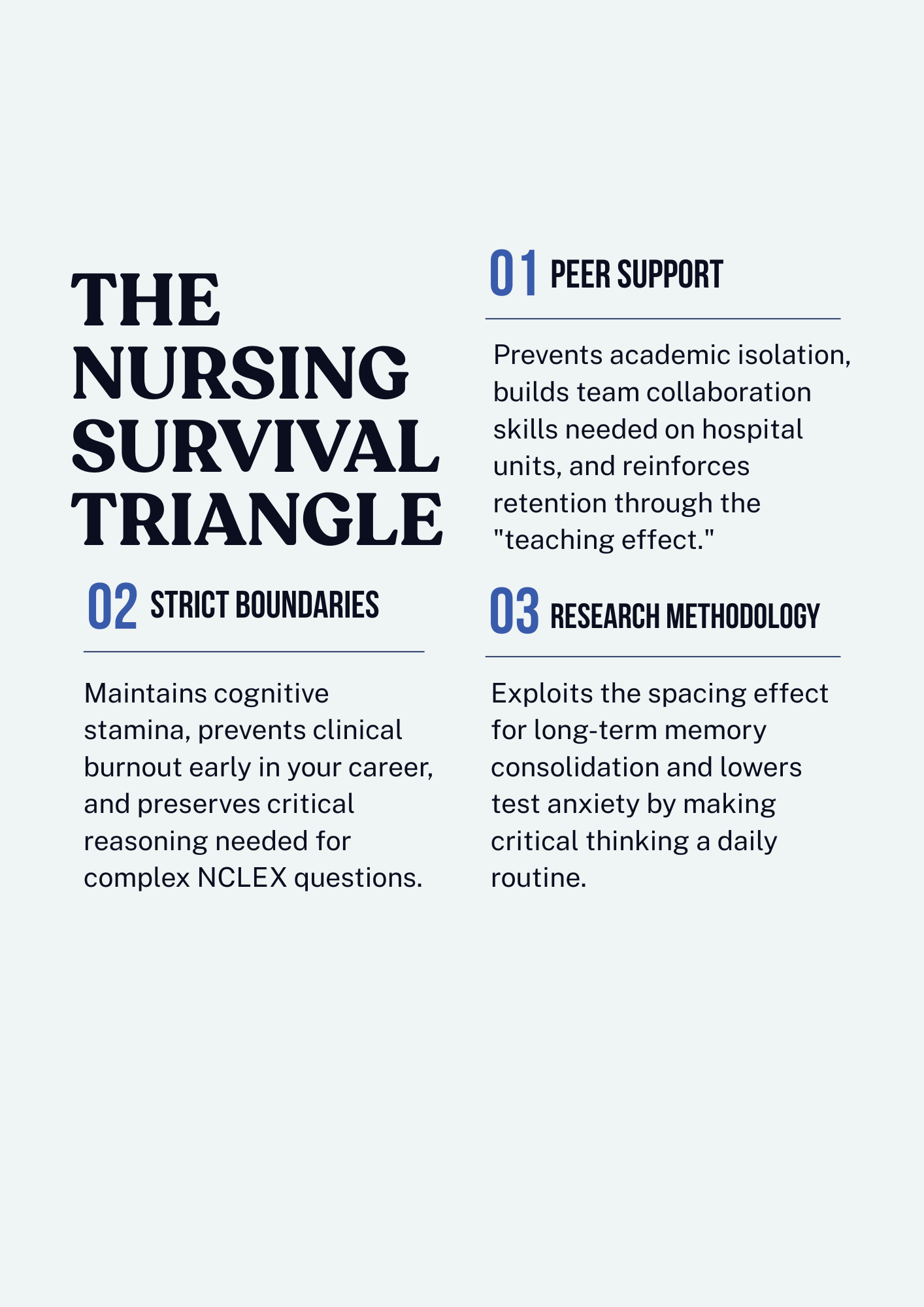
Nursing school is not a solo sport, nor is it a competition against your classmates. The students who thrive are the ones who collaborate.
Find a group of 3 or 4 motivated peers early on. Use your study group to:
- Practice physical assessments: Take turns practicing head-to-toe exams, listening to lung sounds, and going through cranial nerve checks on each other before your practical lab exams.
- Teach each other concepts: The best way to know if you truly understand a condition is to explain it in plain language to a classmate without looking at your notes.
Self-Care Boundaries & Burnout Prevention
It is impossible to pour from an empty cup, and it is impossible to deliver a safe and empathic care to patients when you have been burning the midnight oil with three hours of sleep and coffee.
Sleeping is a Study Technique: The science has proven that memory formation takes place in REM sleep stage. All-nighters before nursing exams are counterproductive since they destroy the ability to think critically which is necessary to answer NCLEX questions.
Keep Your Free Time Free: Choose at least one half day a week when you will be free of nursing studies. Take a walk, spend time with your family members, watch a movie, or practice your hobby. Taking a rest will help you keep your cognitive strength forever.
Final Thoughts from the Bedside
Nursing school is difficult but entirely doable when you strip away all the unnecessary distractions and stick to the essentials on a daily basis. Gadgets and a beautiful environment are not essential; rather, it’s necessary for you to have good equipment and good study techniques.
Each and every nurse you meet on the ward today has been exactly where you are sitting right now, scared, brandishing their shiny stethoscope, and wondering how they were going to remember all those medicines and disease processes.
Breath deeply, get your stuff together, and take a step towards one of the most difficult, but incredibly satisfying paths you can ever walk down.